Review: "Hunger Games: Sunrise on the Reaping" Is A Proper Mind F**k
The latest Hunger Games flick is well and truly polarizing.
Recent ReleaseAt the 91st Academy Awards, John Ottman was awarded the Oscar for Best Film Editing. The film in question? Bohemian Rhapsody, the Freddie Mercury biopic that broke box office records and drew polarized reactions from critics and audiences. Rami Malek won the Oscar for Best Actor, but drew the derision of Queen fanatics. Bryan Singer’s direction was chastised for failing to illuminate the band’s elevation to stardom. The screenplay was criticized for acting more as a flipbook than an exploration of Mercury’s personality.
Yet, with some of the most jarring, scattershot, and confusing pacing ever in a box-office megahit, the editing drew the most ire. When Ottman won the Oscar, aficionados worldwide dropped their jaws in shock and awe. How could this have won the Editing Oscar?
In time, we learned of the chaos happening behind the scenes of Bohemian Rhapsody. Singer was fired during production, story changes forced scenes to take on entirely new meanings, reshoots reframed entire sequences, and the studio’s conflicting instructions forced an accelerated first act.
With all that in mind, many have softened on Ottman’s win, but others remain indignant. Here, it’ll be used to establish precedent for a question no one has been able to answer.
If, on paper, something is bad, but in being bad, it’s as good as it could’ve been, is it bad or is it good?
Let’s see…
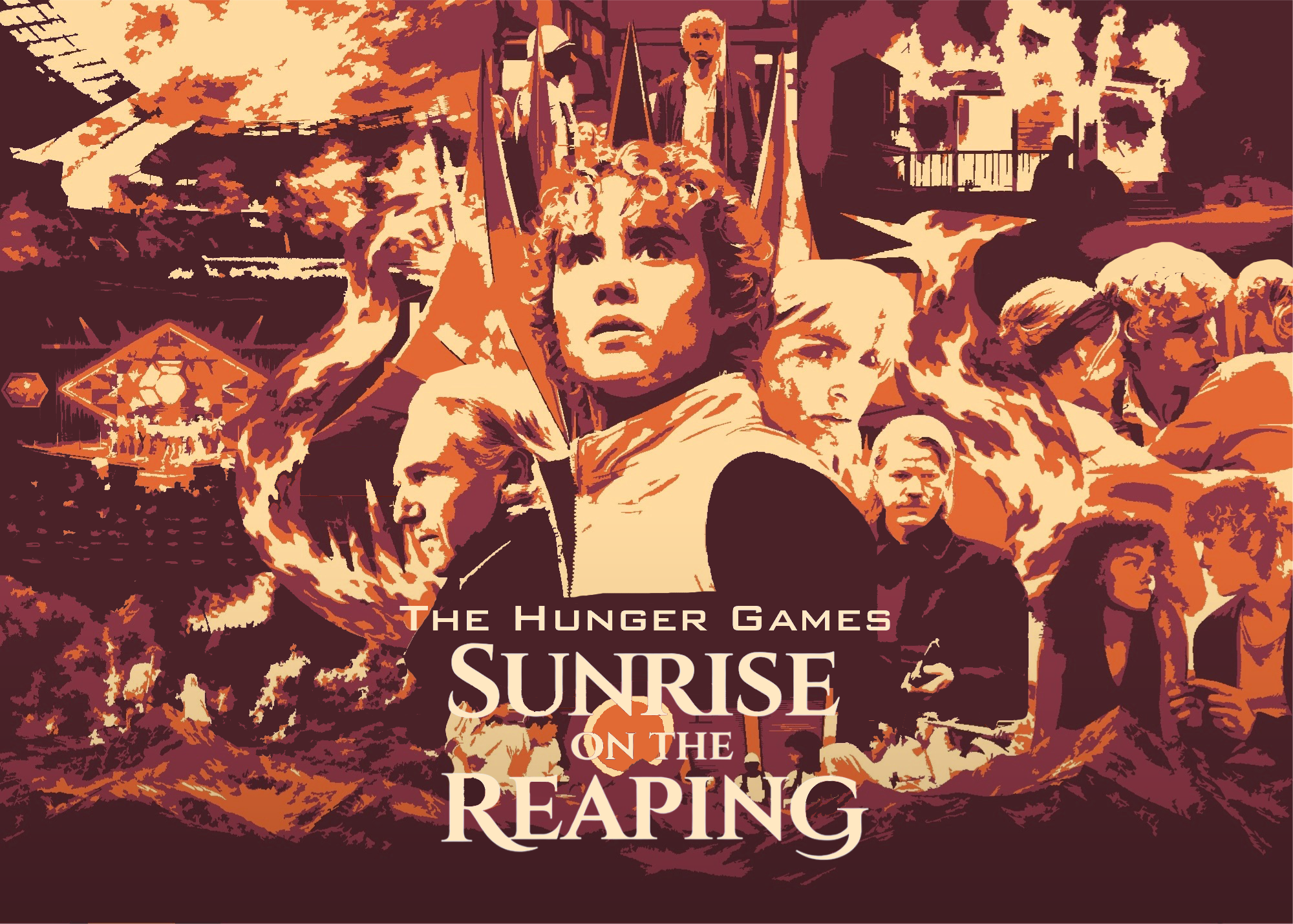
Wake up, everyone! It’s sunrise! On reaping day, no less. Haymitch Abernathy, our favorite smart-mouthed alcoholic victor from The Hunger Games trilogy, is getting his origin story.
It’s the 50th Hunger Games, marking the second “Quarter Quell,” a special Games held every 25 years. This time, twice the tributes will be reaped: 4 from each district, 48 in all. After heroically stepping in to defend his girlfriend, who was defending a grieving mother, who was mourning her dead son, Haymitch is thrown into the Games. Defiant and bold, he has no intention of going quietly, and he joins forces with some familiar faces to “break the machine” and chart a new course for Panem.
In many ways, Sunrise on the Reaping is a very good movie, and a merciful return to form for the franchise after the atrocious Ballad of Songbirds and Snakes. While its saturation feels inauthentic, it's often a visual feast. Its production design is foul, essentially the 1970s through a vaguely sci-fi lens, but its overall scope is admirable. The cinematography keeps you engaged, even when the goings-on aren’t particularly intriguing. If nothing else, this movie holds your attention, and not solely on the back of our familiarity with Haymitch. It has the indefinable qualities only a veteran filmmaker helming a franchise can instill, and for whatever faults, Sunrise on the Reaping is entertaining, though profoundly flawed.
The most glaring issues? In a desperate attempt to earn a PG-13 rating, the violence is muted. As Maysilee lay dying, you find yourself asking why she can’t just rub some dirt on it. There are no skewered necks, gouged eyes, or dangling intestines to be found, which not only foundationally undermines one of the core ideas that drives the film’s allegory, but also leads to some of the most awkwardly choreographed fight scenes in a major film in decades (writer’s note: I have always defended the widely-loathed shaky cam from the first movie for this exact reason, and now feel vindicated).
At 158 minutes, you go in wondering what could need that much time to develop, and you leave feeling that, while it certainly takes its sweet time wrapping up loose ends and delivering a hammy epilogue, it probably needed another 2 hours and 38 minutes to tell the full story.
As we move to the film’s beating heart, we’re polarized again. Joseph Zada shows immense range in his post-game conversation with Plutarch, where the pair spar about morality and virtue in a seemingly hopeless world. Sadly, most of his performance suffers under the weightlessness of Haymitch himself. The boy has none of the personality the man shows in his middle years. He’s stale as old bread and vacant as a small-town motel; the only times we get anything from him are when he’s balling over a dead body or shouting in agony, and neither are particularly convincing. The bite we knew is transferred to Maysilee (played admirably by McKenna Grace), but it’s improperly tempered. She feels like a rehash of a “not like other girls” smart mouth before becoming a vaguely likeable doomed deuteragonist.
How does this happen? How does the one person you needed to properly develop get left in the cold winters of banality and cliché? Because Suzanne Collins, that’s how.
We know who Collins is as a writer, though she’s gotten worse with time. The original trilogy was full of unexplored threads and rushed pacing, but she’s now essentially writing her own fanfiction, with ludicrous plot elements and dialogue straight from the “im14andthisisdeep” playbook. Haymitch and his talking canvas of a girlfriend repeatedly tell each other they love one another “like all fire”; there’s constant talk about painted posters and broken machines. Everyone speaks as no human ever has or will speak.
We’d expect this from a goth girl in a creative writing class, not from a 64-year-old woman. The dialogue is bad enough, but there’s simply too much going on. Truly talented writers understand restraint, when less is more, when the space between the lines does more than the words that comprise them. Collins, with the literary capacity of a burgeoning tween, repeatedly falters, overstuffing her narrative with action that never allows for reactions, undermining a foundational component of character development and plausible storytelling, dystopian world or not.
Katniss was a viable protagonist for many reasons. Cinematically, Jennifer Lawrence was the premier young actress in the industry. But as a character, Katniss was faultlessly constructed. She was quiet but not vacant, competent but not irreproachable, aware but not shrewd, but most of all, she got room to breathe. She reacted to circumstances that felt plausible.
But Collins, bereft of genuine imagination, simply contrives moments to further her characters’ development, which, under a microscope, isn’t development at all. At the tribute parade, a pyrotechnics malfunction spooks the horses, throwing Haymitch’s companion Louella McCoy under the chariots to her tragic death. An overwrought Haymitch marches before President Snow and sarcastically applauds.
Not only have we been given another pre-Games nightmare that makes their enduring success inconceivable, but Haymitch reacts so artificially, so absurdly, it feels like fanfiction.
Even at the reaping, his name is not drawn. Another boy is selected, but tries to escape and is summarily executed. When Haymitch’s girlfriend steps in to defend the deceased boy’s mother, Haymitch intervenes and is reaped in the dead boy’s place. Collins is so amateurish that she’s adopted the most elementary perspective on storytelling: that there always has to be something.
In Songbirds and Snakes, Lucy Gray (who, in another burst of unimaginative silliness, shares a surname and first initial with Haymitch’s girlfriend in Sunrise on the Reaping), is selected. The implication is that her arch-nemesis, incensed over her boyfriend’s dalliances with Lucy Gray, has had her father, the mayor, fix the reaping. Lucy Gray, who has an affinity for and hold over snakes, places one down the girl’s blouse. When she’s beaten on stage for her actions, she slowly rises while she sings a song, which concludes with her yelling at everyone to “KISS MY AAAAAASS!!!”
In the original series, it was a reasonable, plausible occurrence. If every child between 12 and 18 is eligible, someone’s sibling will get reaped, and stepping in to replace them is feasible. But Collins suffers from the false belief she must constantly have some sort of action, something going on, a copy of what came before but ratcheted up, no matter how contrived. This is not a seasoned writer with an acute understanding of story and character, but a published author who’s never developed beyond novice skill level. She has created something allegorical in the vaguest sense, but can’t truly expand on it; without the intellect to understand the nuances, everything falls apart.
For example, if President Snow controls the games, can target tributes at will, and the Capitol understands editing and can utilize tape delays, then why did they show Rue’s death and Katniss’ moving tribute that sparked the riots in District 11, 24 years after Sunrise on the Reaping? Collins went, “Editing happens in reality TV, guys. See?” but couldn’t consider the implications when applied to the world she created.
Frankly, the list of these logic gaps is never-ending. Beetee, the victor of an unspecified prior Games who we know from Catching Fire, takes the blame when the conspiracy to sabotage the Games is uncovered. Snow buys that no one else concocted such an elaborate scheme, and there’s no way to discover otherwise despite having eyes and ears literally everywhere? Wiress, who by the 75th Games has lost all sanity, is here, only a tad shaken up, one year after her Games?
If the Games are punishment for the rebellion, why does Collins write the arenas to be progressively overcharged and superpowered, thus partially undermining the idea that a society under oppressive rule can itself become lost, or that regardless of the injustice of rule, we’re willing to do as expected for people in power if it means we stay alive? Is it because it’s entertainment, as has been repeatedly stated? Fine, then the children are now essentially placeholders for a larger communal experience, which is true of reality TV in many respects, but then who cares about the pretense of the rebellion in the first place?
Even so, the 50th Games is so obtuse in its abundance of trappings it feels corny. We have shock-inducing butterflies and poisonous pollen and killer birds and carnivorous squirrels and erupting volcanoes and on and on and on. It never stops; there’s no restraint, just an unrefined writer overloading the setting to the detriment of the story’s ideas.
So, we have plot holes within the self-contained film and the overarching universe, cringe-inducing dialogue that sounds like it was written by a Tumblr fanfic writer, contrived drama to make our protagonist seem heroic and virtuous instead of allowing him to react to organic scenarios, and a complete lack of understanding regarding the comparisons between the world we live in and the world we’re seeing on screen.
It’s Collins’ fault. It’s all Collins’ fault. She lucked into a great concept, and now, here we are.
So, is Sunrise on the Reaping a good movie because it’s as good as it possibly could’ve been, or is it a bad movie because regardless of its circumstances, there are simply too many ways it’s bad?
The answer? I don’t know. No one can answer that, and it makes Sunrise on the Reaping one of the most frustrating but engrossing cinematic experiences ever. Collins gave Hollywood thematic garbage, but the technical skill gave it life in ways we can’t ignore.
The closest we’ll get to an answer is in one moment, the one scene where we get away from all that nonsense about loving like all fire and painted posters and broken machines, where two people have a genuine, human conversation that sounds like two people actually speaking in a way two people would actually speak, perceiving their circumstances in a way we’d imagine two people actually perceiving those circumstances.
As Maysilee and Haymitch sit atop a rock by the water, she asks him: if she dies, is her sister still a twin? Haymitch assures her that she will always be a twin. If he died, he’d still be a brother to his siblings. After his mother lost twin girls to birth complications, he’s never once doubted that wherever they are, they’re together.
There it is. Right there. Sunrise on the Reaping gives us more insight into the barbarity of oppressive systems, the necessity people feel to upend their oppressors, and the larger questions people pose as they struggle with their mortality than any of the pseudo-philosophical nonsense that came before. If Collins, and thus the movie adapted from her novel, could’ve captured that and stretched it over its ambitious, 158-minute runtime, we’d have had a film that could’ve rivaled Catching Fire (which, admittedly, has its own flaws).
As it is, we have a film that is aching to break free from its constraints, arguably even more oppressive than the child-slaughtering shackles of Panem, but can’t. Are we shocked by this, considering how many films have crumbled under shoddy source material, especially since this one comes from a writer who, at age 64, could only muster the creative heft to use Edgar Allen Poe’s The Raven as a literary talking point between two key characters? No. Can we be frustrated? Absolutely.
But is it bad? It keeps you in your seat. Despite its flawed production design, it’s visually arresting when it matters most. Although its central performance falters more often than it thrives, it has a bevy of good performances. While the score relies on motifs from the original series, James Newton Howard guides the film admirably. It’s genuinely thrilling, shameless in scale, builds anticipation, and, despite its distinct style, captures the general atmosphere of the first two films. In many ways, it’s a good watch. In fewer ways, it’s a great watch.
Sadly, Collins is such a terrible writer that, at this point, no Hunger Games book will ever translate into a genuinely great movie again. Again, does that mean Sunrise on the Reaping is bad? No. But also yes, very. It’s really good, even though it sucks. You should watch it, but don’t analyze it. Although it wants you to analyze it, so you have to, but if you do, you’ll be frustrated, so try to watch it as an action movie, where there’s no believable action, but it’s compelling, even though what would ordinarily compel you was just criticized in a very long review.
Does that make sense? No? Well, life rarely does. Maybe we should just break the Hollywood machine, paint our own poster, and make sure there’s never another sunrise on a bad Suzanne Collins book getting turned into a really frustrating movie.

60
Director: Francis Lawrence
Studio: Lionsgate
Running Time: 158 minutes
Release Date: November 20, 2026
Cast:
Joseph Zada - Haymitch Abernathy
McKenna Grace - Maysilee Donner
Jesse Plemons - Plutarch Heavensbee
Ralph Fiennes - President Corialanus Snow
Elle Fanning - Effie Trinket
Glenn Close - Drusilla Sickle
Whitney Peak - Lenore Dove Baird
Ben Wang - Wyatt Callow
Kieran Culkin - Caesar Flickerman
Kelvin Harrison Jr. - Beetee Latier
Maya Hawke - Wiress
Lili Taylor - Mags Flanagan
Molly McCann - Louella McCoy
Billy Porter - Magno Stift
Screenplay: Billy Ray & MIchael Lesslie
Editor: Mark Yoshikawa
Cinematography: Jo Willems
Score: James Newton Howard