


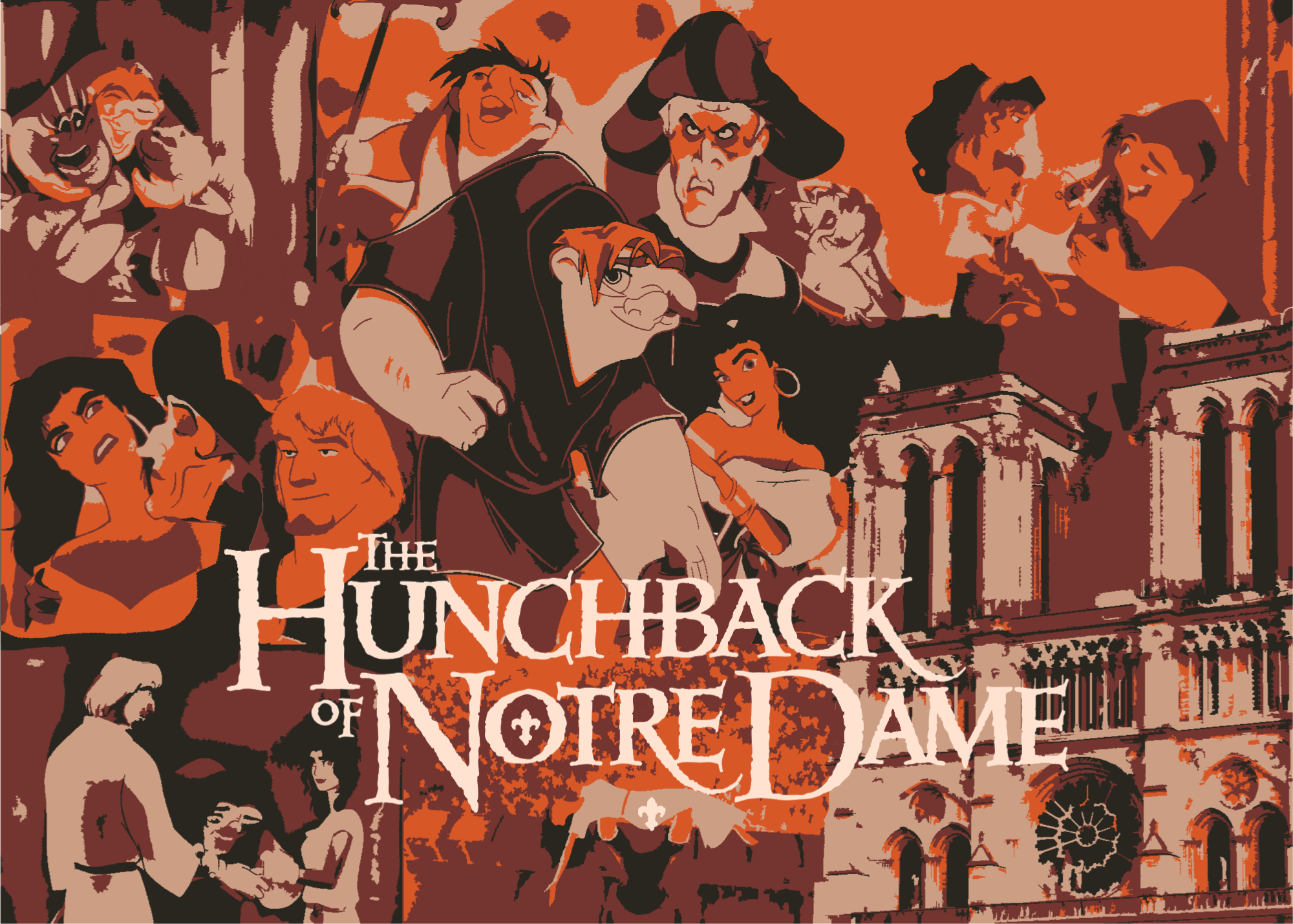
"The Hunchback of Notre Dame:" The Forgotten Gem of the Disney Renaissance
Unlike Esmeralda, it's time to give the Hunchback some love.
RetrospectiveIn 1966, after 43 years at the head of his self-named company, Walt Disney died from complications of lung cancer. Under his leadership, Disney became the world’s animation powerhouse, earning critical raves and massive commercial hauls with films like Snow White and the Seven Dwarfs, Cinderella, and One Hundred and One Dalmatians. Even when WWII decimated the international box office, Disney didn’t give in. He innovated with Fantasia, broke ground with Pinocchio, and captured hearts with Dumbo. Come rain or shine, hell or high water, Walt Disney Productions not only persevered, but thrived.
But after Disney’s death (and his brother and business partner Roy’s five years later), control shifted to Donn Tatum and Card Walker, who gave longtime Disney animator Wolfgang Reitherman creative leadership. Reitherman had been a vital part of the animation team from the beginning. Unfortunately, his family-friendly leanings and old-fashioned techniques kept the studio from evolving, and success waned throughout the 1970s. Creative differences festered, leading longtime animator Don Bluth to take 11 of the studio’s animators and found his own production company. There was trouble in paradise.
Leadership shifted in 1984, when Michael Eisner, longtime Paramount president, became CEO, bringing Jeffrey Katzenberg, who helped oversee the production of Best Picture winner Terms of Endearment and Indiana Jones and the Temple of Doom, as chairman, and Warner Bros.’ Frank Wells as COO. The trio’s first release, The Black Cauldron, received mixed reviews and bombed at the box office, putting the studio’s animation department in jeopardy.
With the emergence of Studio Ghibli and Hayao Miyazaki, Disney needed a big splash. Instead of turning inward, they looked to their competition. Miyazaki’s adaptation of the popular Japanese comic Lupin the Third made extensive use of CGI, prompting Disney to explore the innovation for their own productions. In 1986, with their iconic brand on the line, they used CGI for the two-minute climax of The Great Mouse Detective, and leaned heavily into the new development in their marketing campaign. Although the film failed to outperform Bluth’s An American Tail, it proved an inspired, vital effort for Disney, a critical rebound and commercial bounceback that paved the way for the Disney Renaissance.
It began in 1989 with The Little Mermaid, a film over 50 years in the making. The studio brought stage titans Alan Menken and Howard Ashman aboard and tasked the duo with turning the Hans Christian Andersen tale into a vibrant musical. They succeeded. The Little Mermaid opened to the studio’s strongest reviews and biggest box office receipts in decades, winning two Oscars for Score and Song. The Disney Renaissance had begun.
Over the next ten years, the studio dominated Hollywood, winning Oscars and summiting the box office. Beauty and the Beast became the first animated film ever nominated for Best Picture, and won the Oscars for Score and Song. Aladdin became the highest-grossing film of 1992 and won the studio another two Oscars for Score and Song. The Lion King became the second-highest-grossing movie of all time at the end of its initial theatrical run, and earned the studio, you guessed it, two Oscars for Score and Song. Pocahontas, though not the critical and commercial darling its predecessors were, sparked spirited cultural debates, delivered one of the studio’s Princesses, and, if you can believe it, won Disney another two Oscars for Score and Song.
Disney made a fortune merchandising its beloved characters and churning out direct-to-video sequels from its supersmash franchise starters. Merchandising revenue during the Renaissance reached $3 billion, the DTV films grossed over $1 billion in sales, and The Lion King remains the biggest-selling home video release of all time.
In the thick of the Renaissance, The Hunchback of Notre Dame, though a step up from Pocahontas, took a mild step back in critical reception, failed to outgross its predecessors, and made little cultural impact. Today, it feels like it doesn’t exist: not revered, remembered, referenced, or merchandised. It has no Disney Princess, iconic song, quotable dialogue, beloved sidekick… nothing.
Everything is working against it. Though certainly renowned, Victor Hugo’s original work lacks the widespread significance of Shakespeare’s Hamlet, the basis for The Lion King. It has no historical icon at its center, like Pocahontas, or a central love story, like Beauty and the Beast. It followed so many successes that, without anything overly familiar to stand on or refreshing to offer, it had no choice but to become the red-headed stepchild.
Thus, it did. Hercules, its immediate successor, is the lowest-grossing of all Renaissance movies, but with “Go the Distance,” although admittedly the least-regarded of the era’s central songs, and a legendary Greek mythological hero as its protagonist, it has a wider contingent vouching for it than Hunchback. Mulan, though underserved in its time, is a Millennial darling, and Tarzan ended the Renaissance with nearly $450 million and a final Oscar win.
But Hunchback? Among Disney fans, it gets its due, but it’s largely faded into obscurity. It receives recognition only by virtue of its placement in the studio’s chronology, the “Oh yeah, that one,” of the Renaissance.
Is this deserved? Absolutely not.
The Hunchback of Notre Dame is a treasure, and for reasons that many Disney offerings falter. The story isn’t particularly gripping: a deformed, orphaned young man locked away in a bell tower longs to explore the world. He befriends an individualistic gypsy and helps stop the genocide of her people by his adopted father, the evil Frollo.
You wonder where the meat is, what will pull you in beyond the admirable themes. The Lion King had the tragic death of a parent and a battle to reclaim a rightful throne from a treacherous, usurping uncle. Beauty and the Beast saw the world work against an unconventional romance racing against time.
Hunchback grapples with the potential extermination of a people, but through the lens of a studio that, while deserving credit for broaching ethnic cleansing in the first place, isn’t equipped to explore it properly. This problem is compounded by the fact that, while we struggle to admit it, investment is based partially on familiarity. It was not only Jews who were murdered during the Holocaust. Yes, they were in the greatest numbers, and the entire Nazi regime’s “Final Solution to the Jewish Question” that sparked it all was, in fact, about the Jews. But the Romani aren’t mainstream, so the shock and awe, while sincere, lacks the substance it would otherwise.
So, is the story accessible to general audiences, particularly younger ones? No. Is the studio able to tell it faithfully and with proper urgency? Foundationally, no. Yet, despite the lack of romance for our protagonist, despite the genre’s inherent limitations, despite everything working against it, The Hunchback of Notre Dame is a great movie.
It begins with the central performance of Quasimodo, the titular hunchback. Like many Disney protagonists, his story is innately sympathetic, but Tom Hulce lends one of the most sensitive, understanding performances in the canon. Quasimodo sounds like a real person; his desire for connection is earnest. He expresses himself as we express ourselves. He’s a flawless avatar, but he also feels like a friend, someone we’d want in our lives, someone we’d want to help the way Esmeralda does.
Speaking of which, one must forgive the shock of learning Demi Moore voices the film’s insight into the Romani people. Wooden in live action, Moore found her calling in the studio. Esmeralda’s charisma has warmth: a deeper compassion and fun ingenuity that makes her cinematically personable. She’s a genuine heroine in her humanity and design. Is her romance with Phoebus viable? Not particularly, but even when Hunchback doesn’t quite stick the landing, something about even its misfires is admirable. It’s the result of its lifeblood: ambition.
The Hunchback of Notre Dame wants to be more than the films that came before it, but also stand on its own as a work of art that transcends its Disney origins. It wants to say more, be more, and do more, and in most ways, it succeeds. It could never realize its ambitions, but interpersonally, it’s invaluable for young viewers. Quasimodo latches onto the first inkling of connection he receives and has hope for love with Esmeralda, but like a true friend, he accepts her feelings for Phoebus and wants her in his life regardless of how she wants him in hers. He doesn’t hesitate to save the Captain when his life is in danger; no heartbreak can suppress his character, and that’s what lies at the heart of Hunchback that many films, regardless of genre or target demographic, get wrong.
We often encourage children, and everyone else, to lead with their feelings and honor them, to forgive ourselves for transgressions or understand a wrong choice made over feelings we couldn’t control. Quasimodo is a fabulous role model because he crosses all generational borders. We need to remember that trauma should not stifle spirit, that loyalty should never trample ethics, and that what we feel cannot stand in the way of what is right.
That unshakable integrity makes Quasimodo one of Disney’s greatest heroes, not only because he has it, but because it isn’t forced upon him. He’s not defined by his experiences or put in a role where nobility is built in. Everything he does comes from who he’d be regardless. His virtue isn’t shaped; it’s inherent, and that inherent virtue inspired the film from top to bottom, inside and out.
Menken’s score is operatic, always reflective and fitting, never contrived. Its political progressiveness, though arguably not overly daring, considering Schindler’s List came out only four years prior, feels bold for a Disney movie. It feels unaffected, from the naturalness of its characters, the earnestness of its relationships, and the handling of its subject matter.
But we cannot be so consumed by how expertly the film handles its heart that we ignore its construction. The final act, where Quasimodo rescues Esmeralda from her fiery doom and teams with Phoebus to fight off Frollo and his minions, is the most thrilling sequence Disney has ever done. It’s fiery and urgent, scored impeccably by Menken, and steeped in blazing color, turning Paris into a cinematic inferno. The action is swift, the pacing exhilarating, and it’s all a climactic encapsulation of everything Disney got right in making their most serious movie yet.
Find a film in the studio’s canon with such a grand sense of thematic purpose. Find one addressed with such sincere care and artistic vision. Find one that so beautifully teaches kids to embrace acceptance for their deeds and character, and that fitting a mold is only surface-level. Find one with the relational honesty not to force things where they don’t belong or encourage entitlement based on vague principles. Find one that shoots this high and achieves so much.
Is ambition alone enough to make a movie great? No, and relying on ambition is what ruins many movies and creates false impressions of greatness where it doesn’t exist. But what The Hunchback of Notre Dame proves is the adage plastered on countless grade school walls: shoot for the moon; even if you miss, you’ll land among the stars. As they shine brightly, so do they illuminate movie magic, and few Disney films cast a spell like this one.

91
Director: Gary Trousdale & Kirk Wise
Studio: Disney
Running Time: 91 minutes
Release Date: June 21, 1996
Cast:
Tom Hulce - Quasimodo
Demi Moore - Esmeralda
Tony Jay - Judge Claude Frollo
Kevin Kline - Captain Phoebus
Jason Alexander - Hugo
David Ogden Stiers - Archdeacon
Paul Kandel - Clopin
Screenplay: Tab Murphy, Irene Mecchi, Bob Tzudiker, Noni White, & Jonathan Roberts
Editor: Ellen Keneshea
Score: Alan Menken












Latest Entries
