"Raya and the Last Dragon" Review: A How-To Guide For Ruining Your Kids
One of Disney's worst movies teaches children to be doormats.
ModernIn the long lead-up to the Disney rankdown, I’ll review some of the vaunted studio’s entries in the cinematic animated canon.
Parenting is hard. The world demands so much of our child-rearers. After all, the children are our future; we need to teach them well so they can lead the way.
But how does one do that? Some people aren’t receptive to being taught; a parent can never know what kind of person they’re bringing into the world, and life happens. People get sick, lose jobs, and even if everything goes according to plan, not everyone is a winner.
So, when parents need some “alone” time, or kids get really antsy on a Saturday night and demand endless sugar and pretty pictures, they take them to the movies. You see, movies entertain. Movies inspire. Movies teach, and if you’re not feeling up to teaching your kids, then let a movie do it.
Sadly, not all teachers are winners, either. Some teachers have alcohol problems. Some teachers prey on their students. Some teachers implement NCLB grading curves to rob diligent students of a well-earned A so their incompetent classmates can squeak by 8th-grade English.
The fact is, we can’t know how good or bad a teacher will be until it’s too late. Disney School has been a cherished institution for 103 years, and it’s employed some of the best teachers a child could ever have, like Ms. Mulan, Mr. Mufasa, and Mr. Cricket.
But some teachers are downright awful, none more than Raya and the Last Dragon, which teaches children that they should allow themselves to be exploited, arbitrarily forgive people who repeatedly betray their trust, not assign blame to wrongdoing parties, and view people as redeemable for making self-interested choices at the 11th hour when there was no other option.
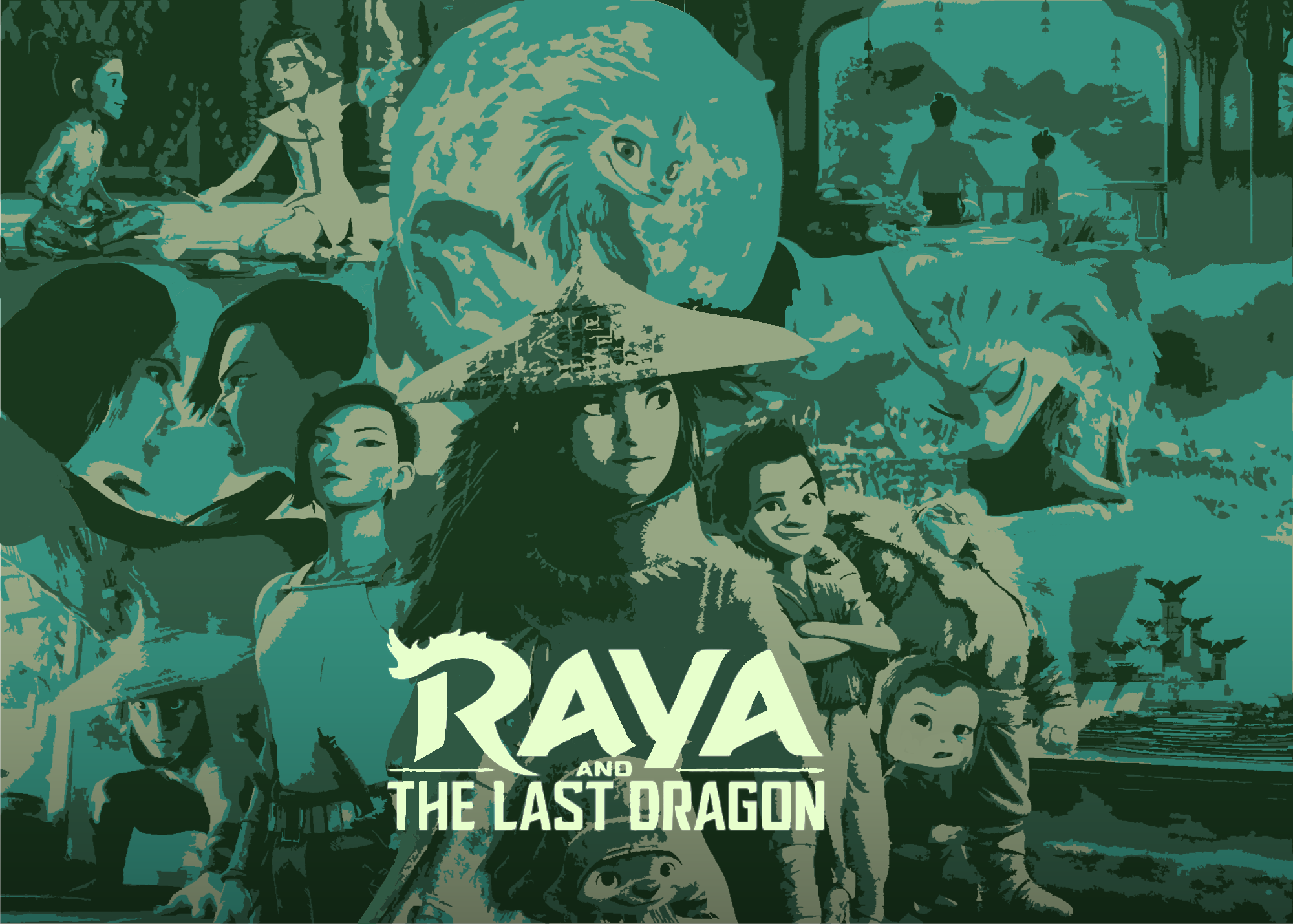
We begin with Raya, who, like so many tween female protagonists over the last decade, is not like other girls (which, ironically, makes her exactly like countless other girls). See, she wants to be the guardian of a sparkling, glowing gem created by Sisu, the last dragon. Centuries ago, when humans and dragons lived as one, the Druun, a plague born from humanity’s inability to honor Rodney King, threatened to wipe out all of creation. In a moment of heroic sacrifice, Sisu concentrated her magic to create a gem that destroys the Druun.
Raya’s kingdom, Heart, guards the gem, which pisses off literally everyone else, so Namaari, the daughter of one of the kingdom’s monarchs, tricks Raya into showing her the gem’s location. Kingdoms break in, chaos ensues, the gem breaks, the Druun escape.
Six years later, Raya tracks down the last dragon, Sisu, in the Tail kingdom. Unfortunately, she’s the least impressive dragon ever. Yet, despite being stone for 500 years and having zero idea how the world works, Sisu spends the film lecturing Raya on how little she trusts people.
Strangely, Sisu’s ardent belief in her principles is almost impressive, considering none of her experience applies to the situation at hand. She repeatedly chastises Raya for her contempt for Namaari, insisting she should be trusted based on nothing but unsupported belief, ignoring that Namaari’s betrayal brought humanity to the brink and that she shows zero recognition or remorse.
Oh wait, do forgive, there is a reason for Sisu’s nonsense: when Namaari was seconds from murdering Raya, Sisu revealed herself as a dragon, and Namaari got teary-eyed, so there’s no way she isn’t a pure soul masked by a steely facade. Even when Namaari tracks down Raya, Sisu and co. and holds them at crossbowpoint, Sisu refuses to back down. Namaari moves to pull the trigger, Raya acts to stop her, and the deflection kills Sisu. Namaari claims it’s as much Raya’s fault as hers, a perspective the movie supports, and one Raya must embrace to save humanity.
Few practices are as damaging to imparting life lessons as extremism, so let’s build to it gradually. Media has repeatedly tried to convince us that nothing should be earned. Trust, loyalty, love, respect, and decency should be doled out on principle and never revoked when violated. The onus is on the decent to do the heavy lifting for the indecent, absolving them each time they transgress.
You may ask yourself why anyone would espouse this perspective, but reflect on your experiences. Has anyone ever tried to convince you that cheaters should be forgiven who doesn’t make selfish, hurtful decisions? Has anyone tried to convince you that abusers can be rehabilitated who doesn’t repeatedly act in their own self-interest to the detriment of others? Has anyone tried to convince you that everyone makes mistakes who doesn’t make more and significantly worse “mistakes” than anyone you know?
The people who insist everyone is redeemable, that trust should be given and not earned, and that the world would be a better place if everyone forgave each other, do so because they’re the irredeemable, because they’re the untrustworthy, because they’re the unforgivable. Teaching children that they owe forgiveness to people who betray trust and exploit good-naturedness is the same nonsense that abusers use to gaslight their victims. Namaari ultimately saves the day: not because Raya sacrificed herself to prove a point, but because she’d have died otherwise.
It’s another horrible lesson for children: if someone acts solely in their self-interest after their hand is forced, that’s the same as doing something redeeming because on paper, the deed is good. Why would anyone want children taught to decontextualize situations to the benefit of the wicked?
Just as opinion is the death of fact, belief is the death of justice. How many criminals have walked free because of religious sentiment or regurgitated pseudo-science or even the passage of time? The severity of an offense is not mitigatable by what someone wants to be true, only by what is true, and the truest factor in any situation is the situation itself. Namaari betrayed Raya, tried to kill her multiple times, directly contributed to the fall of humanity, and caused Sisu’s death.
Somewhere along the way, we became so enamored with our contrarianism that we forgot to care more about reality than the one we created to soothe our egos. Reality: there is no angle only a true intellect can see, no path only a brilliant philosopher can find. Wrong is wrong, and the responsibility for progress and resolution rests with the wrongdoer alone. Enough of teaching children that standing up to injustice is rocking the boat or being unreasonable. Enough of behaving as though holding people accountable is the same as not letting things go. Enough of acting like protecting yourself from people who want to hurt you hurts you more than letting yourself get hurt.
The world needs all kinds of people. The repentant won’t feel incentive to change without reason to believe redemption is possible, but they also won’t feel that incentive without the shame of consequences. However, the one type the world absolutely does not need is the type to behave horribly and get a free pass, because it compromises what the movie forces Raya to compromise: self-respect.
Raya’s adamant that Sisu’s perspective is uninformed and unsupported by evidence, and she’s right. At no point does Sisu trust someone and have it pay off: not when Boun tells her she can buy everything in Talon on credit, not when she’s tricked into nearly getting herself killed by the Druun, not when she places her faith in Namaari not to kill them, never. Not once. Raya is affirmed and vindicated by the very story that betrays her, much like people like her are betrayed by a society that, theoretically, is designed to protect them.
At some point, we became more protective of the abuser than the abused, more concerned with the perpetrator than the victim, and all we’ve accomplished is teaching decent people they owe degenerates something they didn’t earn.
Why do we do this? Because it’s more convenient. It’s easier to manipulate good people to absolve the bad people because they’re more reasonable, akin to how people who are repeatedly rude, obnoxious, and belligerent are excused, but the good-hearted and agreeable get cursed to the seventh circle of hell when they finally snap under the pressure of enduring what’s inflicted on them.
Everyone involved with the story of Raya and the Last Dragon should be ashamed of themselves for adopting such a perverse perspective on humanity and teaching children that they’re obligated to let themselves get treated poorly, that it’s beneficial to give out what should be earned, and that they should let experience be compromised by sentiment. Sisu convinces Raya because centuries ago, her siblings trusted her for no apparent reason, which is extremely damaging. Sisu did nothing to earn that trust, so having it given was foolish, and Raya should’ve stuck to her guns.
If Disney had let Raya hold firm, she would’ve been an amazing protagonist. She would’ve shown that codes should be built by experience, that feelings are not facts, and that if your beliefs are supported by the evidence, stick to them. If you’re wrong, it should be because you’re proven wrong, not because you’re guilted.
Does Raya and the Last Dragon offer anything if you look past its abhorrent messaging? Well, there’s a baby that’s not annoying, Heart looks cool, and Raya, though armed with that singular Disney quirk that got tiresome a long time ago (and hasn’t gone away), spends much of the film as an admirable and valuable heroine, but that’s it. Three things, of low to great importance, none of which matter when weighed against everything the movie stands for. Ironically, this makes the movie itself something its philosophy despises: something so vile that the window dressing is irrelevant.
Please, this is five years too late, but if you’re a parent and you read this, don’t let your children watch this movie. You don’t need a teacher this time; trust yourself, and save them from Raya and the Last Dragon.

18
Director: Don Hall & Carlos López Estrada
Studio: Disney
Running Time: 107 minutes
Release Date: March 5, 2021
Cast:
Kelly Marie Tran - Raya
Awkwafina - Sisu
Gemma Chan - Namaari
Daniel Dae Kim - Chief Benja
Benedict Wong - Tong
Izaac Wang - Boun
Sandra Oh - Virana
Screenplay: Qui Nguyen & Adele Lim
Editor: Fabienne Rawley & Shannon Stein
Cinematographer: Rob Dressel & Adolph Lusinsky
Score: James Newton Howard