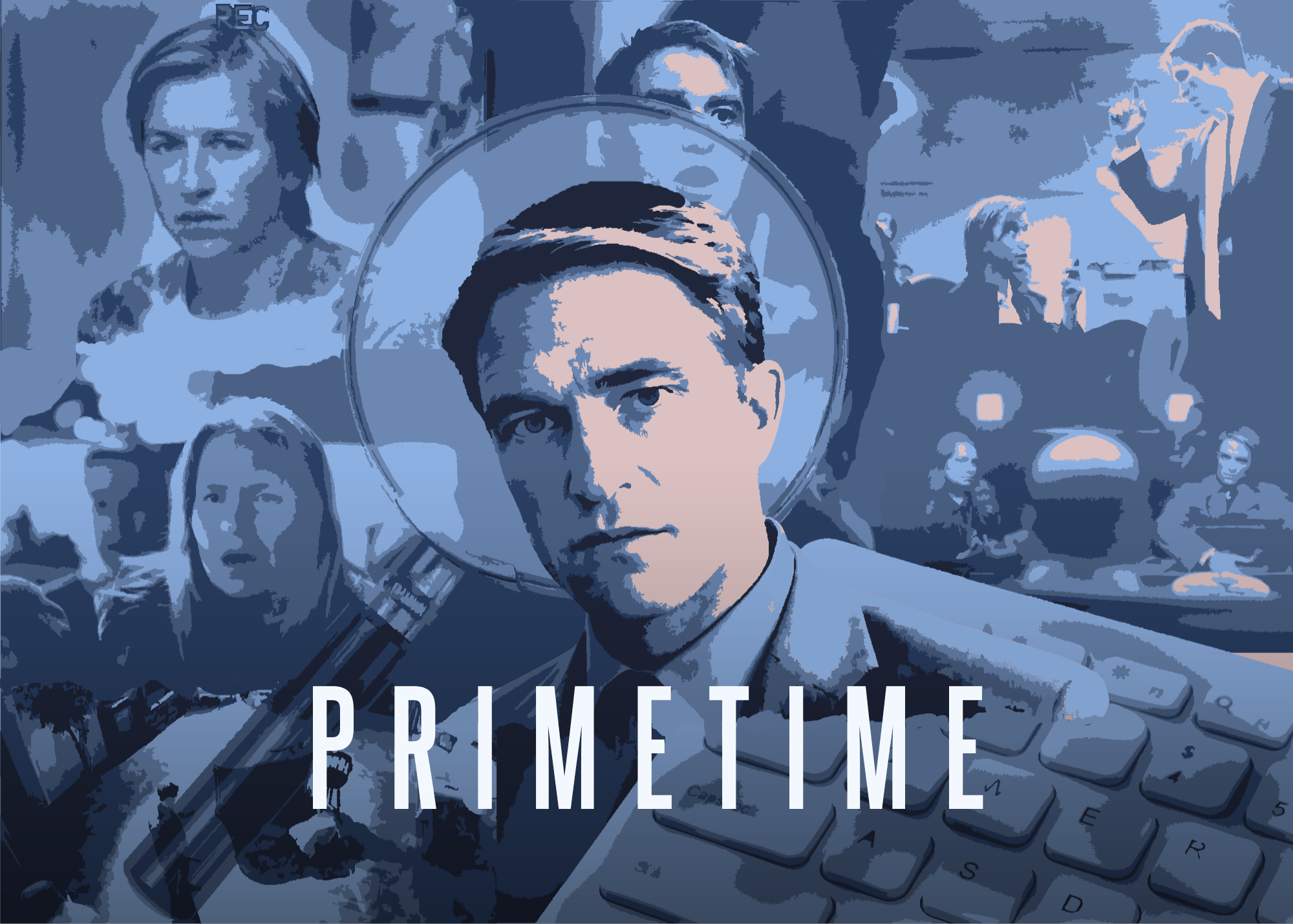
"Primetime" Review: If You Weren't Aware, The Sky Is Blue
Does this boring, pointless movie care to explain itself?
Recent ReleaseIn November 2006, law enforcement in Kaufman County, Texas, and an NBC News crew entered the home of local ADA Bill Conradt. Conradt had recently exchanged sexually explicit messages with a decoy from the vigilante group Perverted Justice, posing as a 13-year-old boy.
The usual setup was contained: NBC, for its To Catch a Predator program hosted by network correspondent Chris Hansen, worked with Perverted Justice, who would use a decoy bait and lure men seeking sex with children to a secured home in a local area. When the men arrived, the decoy greeted the predator before Hansen emerged from behind a curtain and asked about their intentions, often by reading their chats back to them. Eventually, Hansen would reveal that the men were being filmed and would ultimately be televised, and law enforcement would take them into custody.
But this time, NBC deviated. Although Conradt had engaged in illegal conduct, he did not come to the home. When they joined Kaufman County law enforcement at Conradt’s home for the execution of a search warrant, they had gone from filming a bait and switch to actively hunting, and in doing so, captured Conradt’s suicide; he shot himself in the head as police entered the home, in full view of NBC cameras.
To Catch a Predator lasted another year, and NBC settled the $105 million lawsuit out of court in June 2008, so who’s to say how much the incident affected the show’s survival? Hansen claimed the show had “simply run its course,” but we’ll never know how much influence such a shocking derailment of the network’s formula had on the program’s cancellation.
What we do know is that the conversations had in the fallout of Conradt’s suicide were not new. From the show’s beginning, news outlets, blogs, and the public frequently discussed the merits of To Catch a Predator: was it making news or reporting news? Was NBC acting as law enforcement or a third-party reporting agency? Was it blurring the line between ensnaring predators and entrapment? Did the show derail potential convictions, thus acting as a how-to guide for predators seeking to avoid detection instead of educating the public and keeping streets safe?
It makes Primetime one of the most frustratingly pointless movies in recent memory. It’s not a story because there’s no narrative. It’s not a dissection or exploration, because it uses cheap visual gimmicks to create the illusion of high artistry and profundity where neither exists. But most damningly, it’s not illuminating, despite trying desperately to convince us it has something interesting to say, because it behaves as though it’s expository despite telling us something we all knew 20 years ago.
Yes, there’s another side of the predator-catching coin. The producers behind this content don’t have pure intentions; they knowingly support improper investigative techniques for TV’s sake. They’re exploitative, reckless, and unethical; we shouldn’t celebrate their actions, but actively and ardently condemn them. Thank you, Lance Oppenheim. You’re 20 years behind the eight ball.
Even today, we have wannabe Chris Hansens on YouTube, making money off the attempted sexual predation of children by luring pedophiles and filming the fallout for the Internet. No one will get caught feeling sorry for anyone seeking to violate a child, but we will roll our eyes at any neckbeard who sees a pressing social issue, says, “How can I profit off this and feel like a badass?”
It’s unethical, potentially illegal, and jeopardizes legal accountability, meaning these men return to the streets with a sharper eye for warning signs and an ability to maneuver more shrewdly. Meanwhile, content creators rake in views while not fixing the problem they’re documenting for clicks and cash. Again, we’ve known this for two decades, so what exactly is Primetime offering us?
Robert Pattinson does what his director wants: turn the man into a new variation of human slime. It’s a performance whose physicality is admirable (you’ll never see an actor open a flip-phone with such conviction) and overall delivery memorable. Skyler Gisondo, known for being the bumbling, awkward geek in, well, everything he’s ever done, shows something entirely different. He’s ambitiously naive and naively ambitious as Dan, the new decoy hoping that To Catch a Predator will be his big break. His reaction to Jonathan Lipnicki (yes, Jonathan Lipnicki is old enough to portray a child predator) whipping out his hog (yes, you see Jonathan Lipnicki’s penis, you’ve been warned) and covering it with whipped cream is some of the best darkly comic physical acting you’ll ever see. Merritt Wever is fantastic as the sociopathic TV producer, seamlessly blending a warm, condescending TV matriarch with an icy, throat-stepping bitch.
That’s it. That’s the good. Three stellar performances trying desperately to anchor an awful movie. Director Oppenheim thinks what so many misguided creators think, just like so many misguided non-creators think: “If I have nothing interesting or illuminating to say, but dress it up as I do, I can fool everyone.” Conversationally, it’s like listening to that dude in your Film Studies 101 class with greasy hair and horrific BO trying to convince you The Godfather is the greatest movie ever made as though he’s the first person ever to think it. Green to the world of cinema, you initially believe he’s full of wisdom and insight, but a quick Google search will reveal he’s regurgitating talking points he got off Reddit and dressing them up with words he pulled from the thesaurus he read cover-to-cover before term started.
Primetime is the most frustrating sort of movie because you know people like that will fawn over it. The visual nonsense creates the impression of abstraction, leaving its purveyors with two equally enticing options. The first: project whatever onto it, then change your position when someone dismantles it. The second: use the abstraction to solidify a banal perspective, then lord their supposed intellectual superiority for deciphering the glaringly obvious because one person on a forum didn’t clock it.
Reality? Movies should only exist if they’re needed. We need thrilling action spectacles because they distract us. We need provocative thrillers for intellectual stimulation. We need romantic comedies to keep our war-weary hearts fluttering with hope.
We don't need a movie to tell us something we’ve known for 20 years, offer no new angle or insight, then fuck off. We’ve known Chris Hansen is a weirdo. We’ve known To Catch a Predator’s ethics were spotty. We know programs like it exploit the very thing they claim to want to prevent.
If a movie brings you to the theater for $15 a ticket and $30 for concessions, it better have more going on than, “Hey, remember all the stuff we’ve been saying for the last two decades? Yeah, that.” The repetition has zero utility or value outside someone who somehow just realized it patting themselves on the back. Its pointlessness is so aggressive and unrelenting that it’s even boring to discuss because that aggressive, unrelenting pointlessness is the only thing to talk about, unless you briefly commend the performances and condemn all the silly horror aesthetics.
If you’re thinking of watching Primetime, don’t. Instead, talk to someone, even yourself. Better yet, watch To Catch a Predator, rejoice at the offenders’ humiliation, realize how few actually faced consequences, and then go to sleep.

24
Director: Lance Oppenheim
Studio: A24
Running Time: 109 minutes
Release Date: September 25, 2026
Cast:
Robert Pattinson - Chris Hansen
Skyler Gisondo - Dan Plum
Merritt Wever - Andie Bender
Phoebe Bridgers - Del
Anna Faris - Marie Hansen
Tony Revolori - MarriedAndLookingForFun313131
Jonathan Lipnicki - Crazyfrog73
Bokeem Woodbine - Cortland Gunn
Matthew Maher - Xavier Von Erck
Screenplay: Ajon Singh
Editor: Daniel Garber
Cinematographer: David Bolen
Score: Ari Balouzian






































Latest Entries