


%20(13%20x%206%20in)%20(13%20x%204%20in).png)
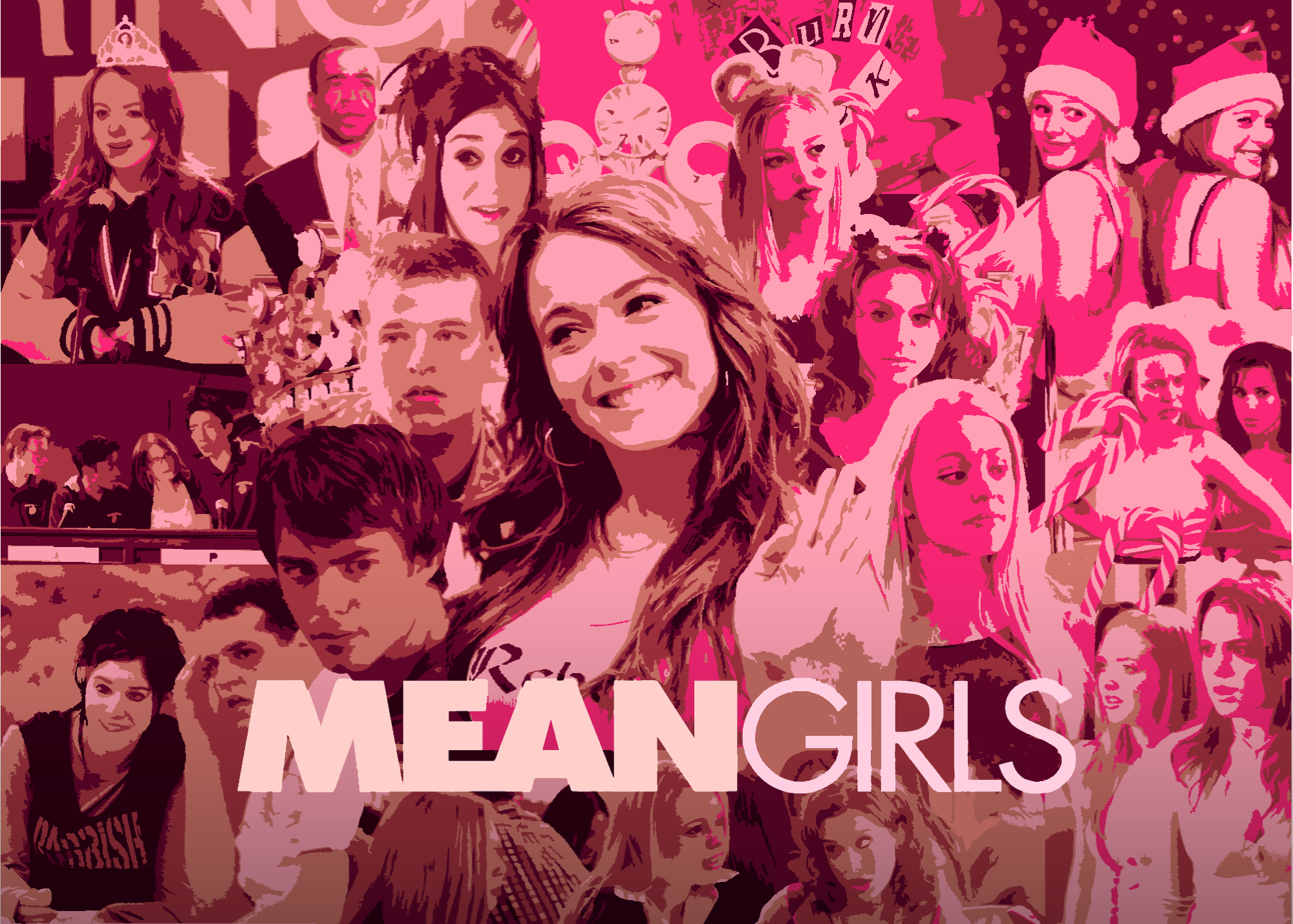
"Mean Girls" Review: A Fantastically Fetch Comedy Classic
This review is like getting punched in the face by Regina George: awesome
ModernIn the opening of the Book of Genesis, we learn how God created the universe. According to whoever wrote the Bible that week, on the first day, He created light to separate it from the darkness. On the second day, He created the sky to separate the waters. On the third day, God created the Remington bolt action rifle, so that he could fight the dinosaurs… and the homosexuals.
Actually, it was Tina Fey who wrote that, though for anyone born between 1986 and 1995, she might as well be God, and if writing the most consistently funny, incessantly quotable, and pointedly expository comedy of the 21st century is equivalent to defeating the dinosaurs and those pesky gays, then she’s earned the worship.
It begins with Cady Heron, named for the guy who follows Tiger Woods around, as she begins her first day of public school. A suspiciously white person who spent her childhood in Africa, she’s departing the freakazoid world of homeschooling for the treacherous jungle of high school’s girl world. Upon arrival, she finds fast friends in outcasts Janis Ian and Damian, the former of whom convinces her to infiltrate the clique of popular junior girls, “The Plastics.”
Not that anyone reading this needs to be informed. Mean Girls has become an irrepressible staple of popular culture, one of the few millennial staples to successfully crossover to Gen Z, evading the buzzword detractions that have petrified an entire generation into fearing any word or deed outside a strict conventional wisdom will be labelled “cringe.” Its jokes remain inoffensive, its stereotypes have avoided condemnation. It has never required retrospection or softening of any kind, because it has always been, and likely will always be, the one comedy everyone can agree is above reproach.
Why? Well, the reasons are plentiful when dissected, but are really quite simple, the first of which is that, of course, it’s fucking funny.
Rare are the films that immediately make you aware of their greatness. In some cases, this is deliberate. Some movies draw you in deliberately, slowly weaving you into the various threads they aim to explore and gradually reveal themselves as a pointed exercise. Comedies don’t quite work that way, but even the best comedies can take their sweet time before earning a laugh.
In the opening two minutes of Mean Girls, Cady turns from her parents’ farewell across the street from her school and walks into the road, only to almost get run over by a school bus. The mother’s yelp is alarming, Lindsay Lohan’s body language is impeccable, and the sound mixing of the zipping bus is overwhelming. It’s everything a good comedy scene needs, an example of how good comedy is just as much a mastery of the filmmaking craft as any high-scale drama. It’s only 120 seconds in, but you know: this is gonna be good, and good it is.
As Cady embeds herself into the popular clique, with Janis and Damian goading her into increasingly foolhardy schemes to sabotage Regina’s life, the hijinks pose many questions, one of which is: who is truly the meanest girl of them all?
Is it Cady, who slithers into the Plastics and parasitically maneuvers her way into supremacy, deceiving her “friend” into devouring countless calorie-dense nutrition bars or trying to get her caught sneaking around with her boyfriend’s teammate? Is it Regina George, who is, in fact, sneaking around with her boyfriend’s teammate, exacts revenge by displacing blame for the treacherous Burn Book on her cohorts, or feigns admiration for people’s clothing only to cruelly criticize them behind their backs?
Is it Gretchen Wieners, who encourages Cady to write ill of the harmless Ms. Norbury in the Burn Book, refuses to take responsibility during the trust fall exercise, and spills Cady’s crush on the dreamy Aaron Samuels to Regina? Is it Janis Ian, who takes advantage of a new student looking for friendship by convincing her to exact revenge on her behalf, compromises the physical health of a classmate, and generally displays a lack of respect even for those in her social circle?
Is it Karen Smith, who… it’s not Karen.
We could debate forever who deserves the title of “Meanest Mean Girl,” but doing so would be losing the comic value of the movie. Everyone is a mean girl, and artfully crafted to avoid being too offensive for humor. As petty, cruel, mean-spirited, and vindictive as the girls’ actions are, they’re never so horrid that we can’t laugh, and sometimes the humor comes from a perverse sense of admiration. The teenagers’ industriousness feels like, under the right circumstances, a net positive for society. Imagine if, instead of tricking high schoolers into catching their cheating girlfriends to topple their stranglehold on girl world (though an arguably admirable task in concept), they channeled that energy into actual law enforcement? Not to mention, Gretchen really should stop trying to make “fetch” happen: it’s not going to happen.
But that’s the magic of Mean Girls, faultlessly paralleling not only the hormonal mania of adolescence, but also the harsher realities of adulthood. It’s aged well because it’s a disappointingly perfect encapsulation of every social situation life throws at us. Jobs will always have cliques, friend groups will always have hierarchies, and we’ll always find ourselves in one compromised position or another. Perhaps we’ll be the immature brat who still has a lot to learn. Maybe we’ll be the aimless parent, navigating uncharted waters as our child turns into someone we don’t recognize. Maybe we’ll be someone with the best intentions who gets exploited. Maybe we’ll be a jilted lover with the name “Kevin G!” reverberating through our eardrums.
Whoever we are or whoever we become, intentionally or otherwise, Mean Girls will always have our back. It will make us laugh harder than most comedies, but many movies make us laugh. Enduring appeal and popular reception require something deeper, something necessary. Without Mean Girls, who among us would know that if we have sex, we will get chlamydia, and die? How would we have learned that actions have consequences, but only if you haven’t already paid the DJ? How would we know that someone can use super jumbo tampons and still be a virgin? Who would’ve taught us how to push ourselves, like a teacher falsely accused of selling drugs?
So, for all the iconic memes born from its quippy comic bite, the enduring mass appeal of Mean Girls lies in its insight into not only the foundational aspects of the adolescent experience, but the realities of life that extend deep into adulthood. We never stop breaking into cliques, alienating, and othering to mask our insecurities and protect our interests. And you know what? Despite the endless parade of rationalizations, it is just as fallacious a practice at 40 as it was at 16.
The only truth we need is the truth of who we are, and the only person that needs to matter to is ourselves. Capturing that universal yet easily forgettable truth with as much humor as heart is a feat we marvel at over 20 years later, and for good reason. Without movies like this, we can’t laugh the way we need to, particularly in times like these. But without them, we also can’t reflect on whether we’ve grown as much as we’d like to imagine. We can’t ask ourselves - and answer truthfully - if we’re still mean girls. The answer may be yes, the answer may be no, but if we ever need a growth check, we can always come back to the defining comedy movie of the 2000s and laugh our heads off to get it.

92
Director: Mark Waters
Studio: Paramount
Running Time: 97 minutes
Release Date: April 30, 2004
Cast:
Lindsay Lohan - Cady Heron
Rachel McAdams - Regina George
Tina Fey - Sharon Norbury
Lizzy Caplan - Janis Ian
Lacey Chabert - Gretchen Wieners
Amanda Seyfried - Karen Smith
Jonathan Bennett - Aaron Samuels
Daniel Franzese - Damian
Tim Meadows - Principal Duvall
Amy Poehler - Mrs. George
Rajiv Surendra - Kevin Gnapoor
Neil Flynn - Chip Heron
Ana Gasteyer - Betsy Heron
Screenplay: Tina Fey
Editor: Wendy Greene Bricmont
Cinematographer: Daryn Okada
Score: Rolfe Kent





.jpeg)













.png)


.png)
