


%20(13%20x%206%20in)%20(13%20x%204%20in).png)
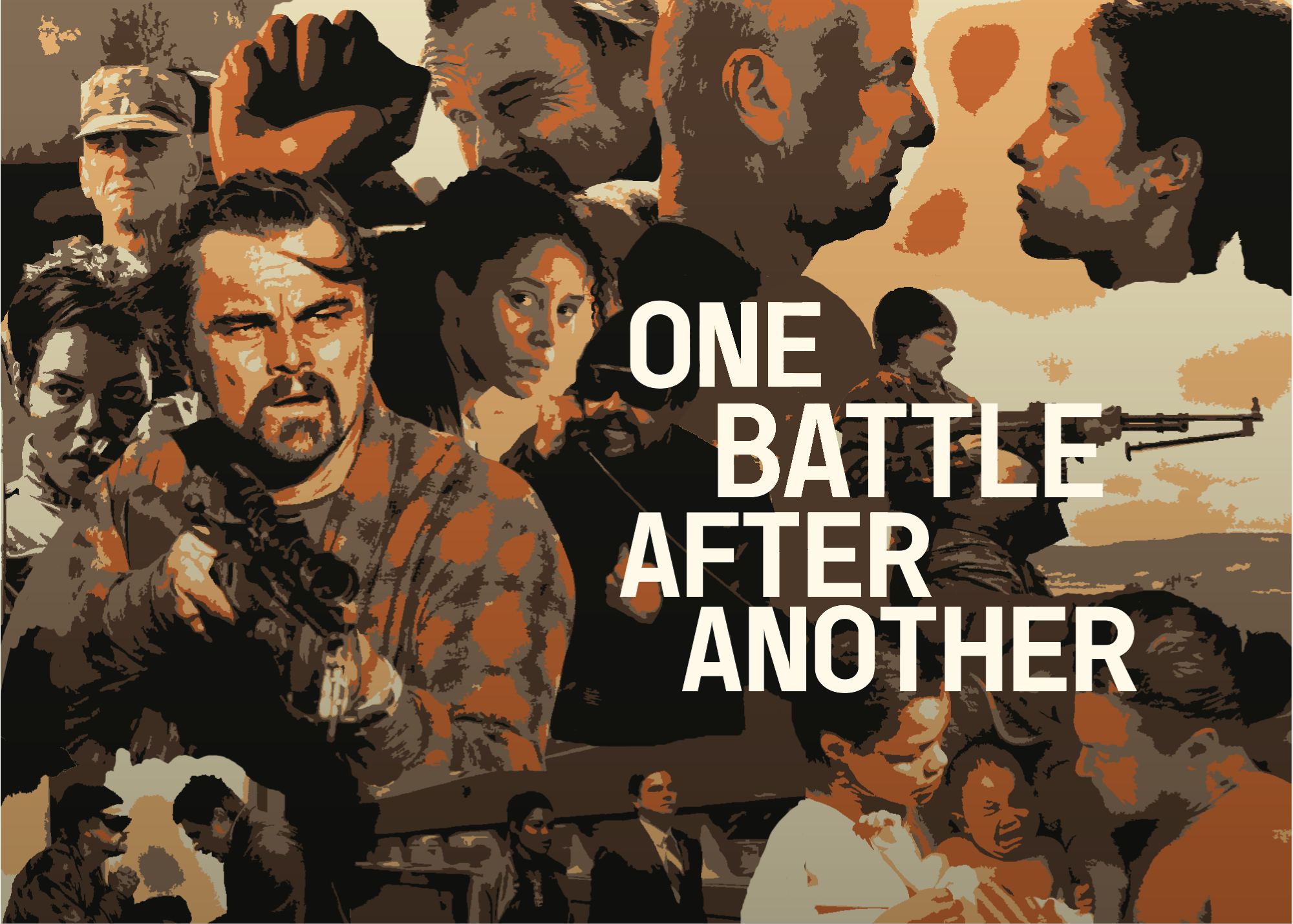
"One Battle After Another" Review: A Truly Good Movie - But Nothing More
Paul Thomas Anderson's newest flick is an entertaining genre blender, but the hype isn't quite earned.
Recent ReleaseIn 480 BC, Xerxes I and his 300,000-strong Persian Army marched on Greece in their second attempt to conquer the ancient empire. After the Persians reached Thessaly, Leonidas I of Sparta marched 300 of his men to the pass at Thermopylae and, with several thousand soldiers from neighboring Greek city-states, blocked the Persian advance.
Through two days of gruesome battle, the Greeks repelled the Persian forces, but there was one chink in the outnumbered Greeks’ armor: a path that led over the mountains and connected to the main road behind the Greek lines, which would allow the Persians to flank and decimate the Greek forces. So long as this path was a secret to Xerxes, the Greeks could hold. Unfortunately, a Greek renegade named Ephialtes sold out his people to the Persians and informed them of the trail. Xerxes capitalized on the opportunity and marched part of his forces over the mountains, surrounding the Greeks. In one of history’s most famous last stands, a small contingent, including Leonidas and his 300 Spartans, fought the Persians to the death.
Why did Ephialtes betray his homeland? We cannot know. Perhaps it was to rectify some perceived slight. Maybe it was to gain favor with what seemed the winning cause. For all we know, his dead father appeared in the night sky and told him what to do: it’s been known to happen.
The fact remains: betrayal is one of the most inciting acts someone can perpetrate because it is the one thing of which no one can conceive themselves being capable. Sure, we love to judge people on the Internet for any minor infraction to convince ourselves we’re infallible and righteous, but among trusted friends and in the deepest recesses of our minds, we know we’re flawed. We get angry and lash out. We give in to impulse and buy something outside our price range. We suffer from forgetfulness and miss important things. But betrayal? We would never do that.
Of course, many of us truly wouldn’t do that, but some of us would. Otherwise, no one would ever betray anyone. Therefore, movies have a very interesting opportunity. In real life, if we’re betrayed, we can avoid the person who wronged us entirely. If we’re watching a movie, while we could just switch to something else or leave the theater if we find something too objectionable, we won’t. We’re going to watch and try to understand why someone would betray something seemingly dear to them and the people they love in the process.
So, when Perfidia Beverly Hills, an ardent revolutionary and beloved member of the French 75, informs on her fellow group members and enters the Witness Protection Program, Paul Thomas Anderson’s new Oscar frontrunner, One Battle Another, has the chance to explain to us the motivations behind one of the most foundational and visceral human behaviors. The verdict?
Good enough.
Anderson’s movies have always felt pointedly aimless, inviting analysis with his stylistic approach but offering little thematic meat. It is the hallmark of every filmmaker who endears themselves to arthouse crowds but struggles to attract the masses: look different, feel different, but don’t actually be different.
As such, the intention has always seemed to be seeming meaningful without putting in the legwork to actually be meaningful. One Battle After Another is arguably his most interesting film because it feels the least ambitious, a likely reason why it’s the first to seem fated for Oscar glory.
Perfidia represents a divisive figure: those righteous activists whose virtuosity borders on egomania, where the espoused ideals espoused become enmeshed with a self-aggrandizement that ironically makes the cause harder to champion. She’s fearsome, but behind her relentlessness is the breed of aimlessness and insecurity that only the most vocal proponents of a movement possess. She folds under pressure, yes, but she folds easily.
For the next 2 hours, the movie stuffs itself with a bevy of philosophical angles, like the lunacy of extremism regardless of political affiliation, the viability of community, how to establish identity, and the purposefulness of revolutionary activism, but most of it goes underdeveloped or unaddressed entirely. It’s largely a movie that feels like it wants to vaguely be about enough ideaologically to earn critical raves but ultimately be little more than a movie about a father and daughter (which, for the record, is completely fine).
So, with it sounding much like a thematic treasure trove, why is One Battle After Another not a masterpiece? Because it wants and tries to be too much foundationally while simultaneously wanting to be nothing too concrete, leaving you to find too much yourself, and that’s just not interesting.
Yes, conceptually much was given, but movies are not worth their weight in Oscar gold if they make you do the heavy lifting. Anyone can pose a question or float an idea. If we wanted to do that and bat it around, we could grab a beer with a couple of buddies. We don’t need movies in that way. The truly great films decide things decidedly and (preferably with tact) insist upon them, and Anderson’s work, though acclaimed, has never been particularly insistent. Maybe it’s actually his ardent supporters who misinterpret his work and thus set him up for failure outside that bubble, but even if not as much as it appears, it remains true nonetheless.
However, there are ways in which this works. There is a moment, after 75er Deandra rescues Perfidia’s daughter, going by Willa, from the incoming raid of Colonel Steven J. Lockjaw, the virulent racist who fathered her, and takes her to a convent run by revolutionary nuns. One of the nuns laments her old age and says she “got sick of this shit a long time ago.”
If there’s one theme Anderson truly hits at, enough to earn some real contemplation and deep introspection from his audience, it’s this. With the world leaning into conservatism and the extremist powers operating unchallenged, those who initially took up the mantle are beginning to ponder how much longer this will take and whether the result will look as they’ve imagined. Many decry the violence and harsh divisions and simply want their country to heal, but one must ask what exactly that healing looks like. Healing implies returning to the original state, or at least a functional one, but what would our country look like if it did, in fact, “heal?” It’s always been fiercely divided, deeply prejudiced, and one where the rich get richer, and the poor get poorer. Who wouldn’t get tired of fighting?
As it grapples with, say, the future of activism and what its warriors’ vision of it will look like as extremists from both sides muddy the waters or how people’s identity is shaped from where they come from and influences whether they chart their own course or take up the torch of the previous generation, we ponder whether One Battle After Another has mastered showing and not telling or simply shows things without the ability to grippingly elaborate on them.
For example, would Willa’s arc be more interesting if she hadn’t been raised by her leftist father, Pat, and instead discovered her true identity and been forced to decide on her own? One could argue that her contentious relationship with Pat is designed to make her ultimate choices more difficult in this regard, but she’s a teenager. How far are we expected to stretch?
It’s admirable, and skillfully crafted enough, with fantastic performances and sharp scripting, that it does occasionally soar as high as it aims, and does inspire some degree of feeling. Alas, it feels thematically like a recipe with too many ingredients. No particular elements stand out; the flavors are not each detectable.
So, we’re left with a movie that scores “well” for its ideological ambition, yet it is still a very good movie. Why? It’s really fun to watch.
Although it does struggle with pacing, it’s engagingly cut. Many of its humorous aims land because of clever camera work and sharp comedic timing. Dramatically, more is said with simple looks than a thousand words could ever convey, and the cinematography feels dire and urgent, with fantastic lighting and use of color and some excellent shot composition, particularly in moments where trust is at a minimum, like Deandra’s driving Willa to the convent. Rarely are characters far from one another, and much of the drama happens in the dark. A more skilled director could’ve maximized this, but Anderson does enough to make the movie feel important, albeit lacking true tension.
It’s engagingly filmed, with cinematography that’s as suffocating in its more intensely interpersonal scenes as arresting when capturing its desert landscapes. It’s faultlessly acted, whether from Teyana Taylor as Perfidia in a showier role with little screen time or from Chase Infiniti in a subtler role with significant screen time. Jonny Greenwood’s score, while occasionally distracting, keeps the proceedings lively and prevents the movie from becoming too brooding or self-indulgent. It may not be the thriller or comedy or societal dissection its rabid fans claim, but it’s enough of each of those things to become a good movie with all the technical mastery powering it.
Reflectively, perhaps One Battle After Another deserves more credit. Perhaps its ambition feels so impossibly seismic because there are truly that many issues facing our nation today. People are going to have to make difficult choices, not just decide which side they’re on. People will prove themselves to be a Rosa Parks or Nelson Mandela, others an Ephialtes or Perfidia Beverly Hills. People will have to prove their words are actionable or stay behind a monitor and pat themselves on the back. No movie could capture it all, but each one deserves to be addressed.
Ultimately, it’s a movie very much worth watching, whether as someone looking for commonality with artists who can get a message out there or a cinephile looking to marvel at the technical work. No one can argue it’s not a worthy contender for the Academy’s big prize in a relatively weak year, but it’s always worth noting when a movie doesn’t quite achieve what it sets out to because that’s how the next generation is going to succeed at doing what their forefathers couldn’t. After all, isn’t that (in some ways) what One Battle After Another is about?

81
Director: Paul Thomas Anderson
Studio: Warner Bros.
Running Time: 162 minutes
Release Date: September 26, 2025
Cast:
Leonardo DiCaprio - “Ghetto” Pat Calhoun/Bob Ferguson
Chase Infiniti - Willa Ferguson/Charlene Calhoun
Sean Penn - Col. Steven J. Lockjaw
Regina Hall - Deandra/ “Lady Champagne”
Benicio del Toro - Sergio St. Carlos
Teyana Taylor - Perfidia Beverly Hills
Tony Goldwyn - Virgil Throckmorton
Alana Haim - “Mae West”
Wood Harris - Laredo
Shayna McHayle - “Junglepussy”
Screenplay: Paul Thomas Anderson
Editor: Andy Jurgensen
Cinematographer: Michael Bauman
Score: Jonny Greenwood













.jpeg)


















.png)


.png)