


%20(13%20x%206%20in)%20(13%20x%204%20in).png)
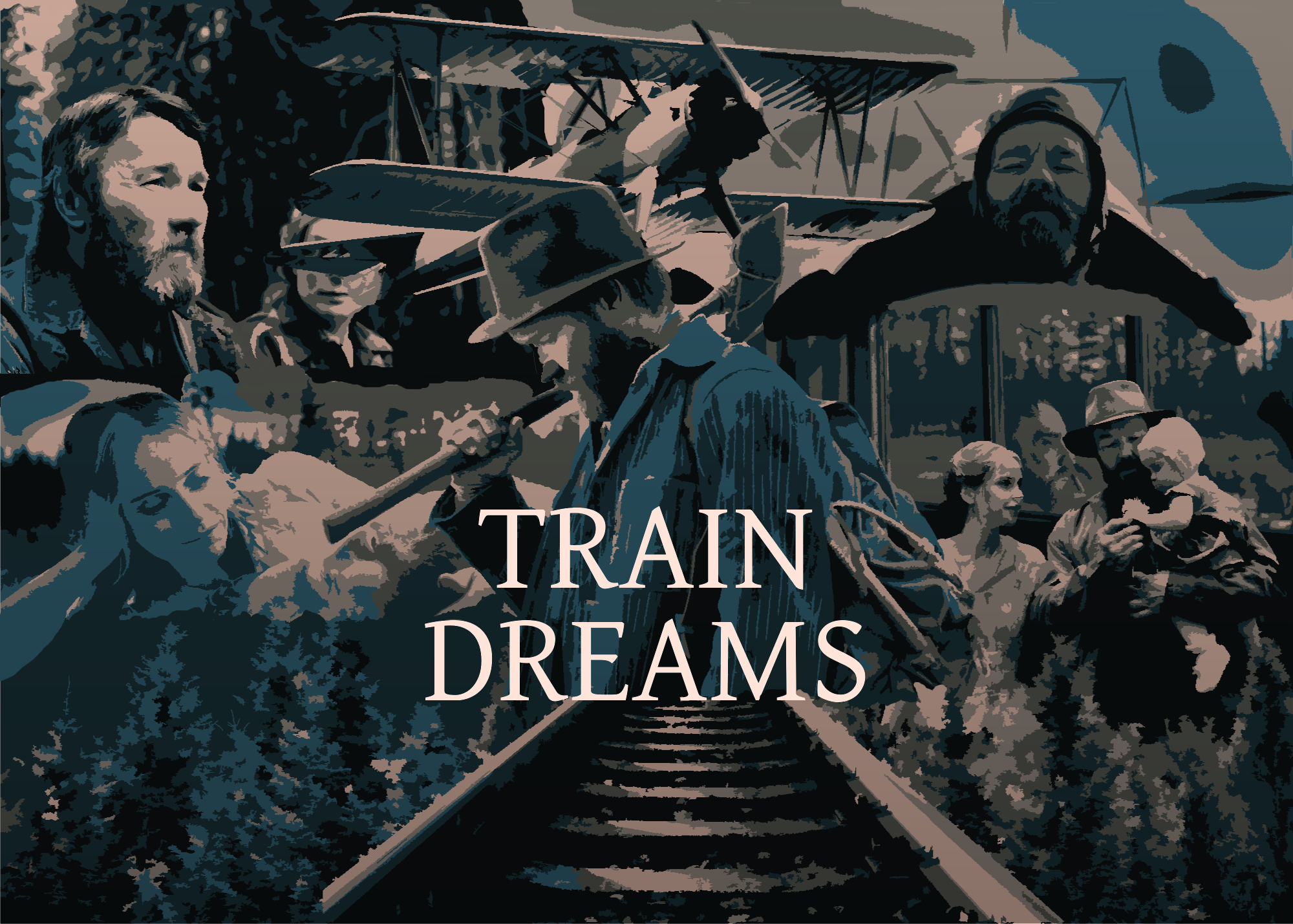
"Train Dreams" Review: A Passionless Passion Project
Love is not enough to prevent this dull drama from feeling like labor.
Recent ReleaseIn 1903, at Huber’s, a dime museum in New York City, Edwin S. Porter’s The Great Train Robbery had its first known showing. It was the very first narrative film, a 12-minute Western about an outlaw gang that robbed a steam train and then fled across the mountains before getting defeated by a local mob.
Over the last 123 years, we’ve found every way to tell a story on screen: romance, comedy, tragedy, drama, horror, science fiction, and within every possible genre we’ve blended, conjoined, and divided. We’ve seen films with massive tonal shifts, nonlinear editing, aggressive scoring, and every style of cinematography. At this point, being different is nearly impossible; many movies fail because they reach for that unreachable star.
It isn’t that pushing boundaries is inherently wrong; film wouldn’t be where it is today without innovation. It’s that earnestness can be distracting; even when a creator respects their story, it may not always show. It’s the same as being in a romantic relationship. If you love someone, you must show it, but in a way that resonates with them specifically. Everyone is different, so how we each receive and process love is different. Hence, everyone will have a different opinion even within like-minded groups.
One can only speak for themselves and, by definition, for some others as well, but sometimes an approach can result in a film that strains credulity so much that empathy for those who think differently is almost impossible. Train Dreams, the seemingly contemplative period drama that’s been nominated for the Best Picture Oscar, is one such movie.
Unquestionably, director Clint Bentley cares. Train Dreams feels deliberate but never pretentious; even if disliked, the style usually feels intentional and part of a grander vision. It’s what keeps the movie from being insufferable or seeming like an exercise in cinematic masturbation, but it's sadly not enough to elevate a dull movie to greatness.
If it were, we’d have something introspective and moving, but Bentley’s personal direction only takes us so far. In the moment when Robert, a logger, lies with his girlfriend Gladys by a lake in Idaho, we witness one of the most intimate scenes in recent memory. He wants to marry her; the sound of her voice saying his name inspires this longing. It’s romantic, not in the floral sense or the chocolate sense or the sweeping, grandiose gesture sense, but in one specific to this movie and these characters. While plucked from the book, Bentley directs it with a sincerity and sensitivity that makes it clear he has emotional parallels with the moment. It’s rare when you can sense a director truly directing, where it’s clear a performance was influenced from behind the lens, but this is one of them. Bentley understood this love, and it shows.
Sadly, outside of that one moment, Train Dreams is an exercise in passion that feels entirely passionless. Reading about the film’s production makes it clear that its creation was urgent, born from a deeply rooted desire to create something impactful. Unfortunately, it’s ultimately something you want to commend for all the things it aims to be, rather than for what it becomes.
In a moment like Arn’s (a sage-like pseudo-naturalist Robert befriends on the job) speech about the intricate stitchings of the world’s ecosystem, using a bizarre metaphor about Ferris wheel bolts to explain the arrogance of humanity, it feels like Train Dreams loses sight of itself. The naturalness of Robert and Gladys’ romance gives way to the pontification of humanity’s grandest follies, spoken with the same degree of wisdom you’d find in a freshman year philosophy class. The film goes from not needing to try to trying harder than any movie should, and what could’ve been something great becomes something dull.
It’s a shame, because as an entire generation of millennials stares down the reality of getting screwed out of home ownership and retirement, as their efforts to instill social equality collapse under the weight of Boomer and Gen-Z conservatism, we gaze forlornly at the world shifting away from what we aspired to make it. Yes, there were delusions, and some of them of grandeur, but it was not just a dream; it was slowly (but surely) becoming a reality. True, the corn fields of Iowa and the plains of Nebraska would never come around, but the ability to live freely, truthfully, and without intervention, so that at least all the necessary options were available, was manifesting.
With that in mind, there’s an entire generation of people for whom Train Dreams is nothing but a limp lament on what could have been, the unfounded ambitions and unrealized dreams. It has one moment where it shows what it could’ve been and spends the rest of the time trying so hard to feel natural, unaffected, and profound that it feels intensely unnatural, affected, and lacking profundity.
Anyone can employ referential storytelling or cinematography, but what are those but easter eggs for cinephiles? Movies should not be deferential to films of the past or self-congratulatory for their isolating inclusivity. If you want to have meaning, then have it; much like an actual human being, the appearance of personality is not a substitute for an actual personality. Being different nearly 125 years after the first narrative motion picture may be impossible, but celebrating that impossibility isn’t a way to impart anything worth absorbing.
Train Dreams isn’t meditative because meditation requires true focus, anchoring your thoughts, and restructuring when the mind wanders. Its gorgeous cinematography and incessant scoring try to convince you it possesses these qualities, but they’re ineffective. A quiet film needs time to develop and room to breathe; it cannot be flipped through like a chapter book, hopping from event to event, a feeling which the insufferable narration and rushed editing compound. At film’s end, we’re expected to be moved by the unsubtle conclusion of Robert being told by the biplane pilot to “... hold onto something” as he flashes back through his life (and some deviations to provide comfort), but for what reason? Everyone he met simply held positions and had titles. Gladys was his wife, Kate was his daughter, Arn was his friend, etc., but what meaning did that have beyond a concept? We’ve watched countless husbands lose their families, and lots of protagonists’ friends die. Why is this movie worth investing in?
Frankly, that question is unanswerable because it isn’t worth it. If a film wants to draw you in, it cannot simply offer a different approach; the approach itself has to offer something worthwhile. The relationships require deeper context, true weight and development. No film is long enough to explore every angle and pull every thread, but they are long enough to do more than one lakeside chat or saccharine speech by a campfire. The story has to feel like it's taking you somewhere, not floating something and asking its audience to draw all the conclusions, because anyone could do that. Any human on earth could go anywhere or to anyone and say, “Hey, guys… this,” and it would be just as banal and worthless as having a movie do it.
Ultimately, Train Dreams wants from us something we’ve given to countless superior films, so the only merit on which it would earn that is by asking it in a different way under different circumstances, ones that it executes well. Sadly, it’s too hesitant to elaborate on anything to make the story engaging beyond the most overused ideas imaginable, leaving it something that you can recognize but not truly feel. Without that familiarity, it’s just another movie wanting to be meaningful but getting lost in understanding how to make that dream a reality.

47
Director: Clint Bentley
Studio: Netflix
Running Time: 102 minutes
Release Date: November 7, 2025
Cast:
Joel Edgerton - Robert Grainier
Felicity Jones - Gladys Olding Grainier
William H. Macy - Arn Peeples
Kerry Condon - Claire Thompson
Will Patton - Narrator
Screenplay: Clint Bentley & Greg Kwedar
Editor: Parker Laramie
Cinematographer: Adolpho Veloso
Score: Bryce Dessner







.jpeg)










.png)


.png)