%20(13%20x%206%20in)%20(13%20x%204%20in).png)
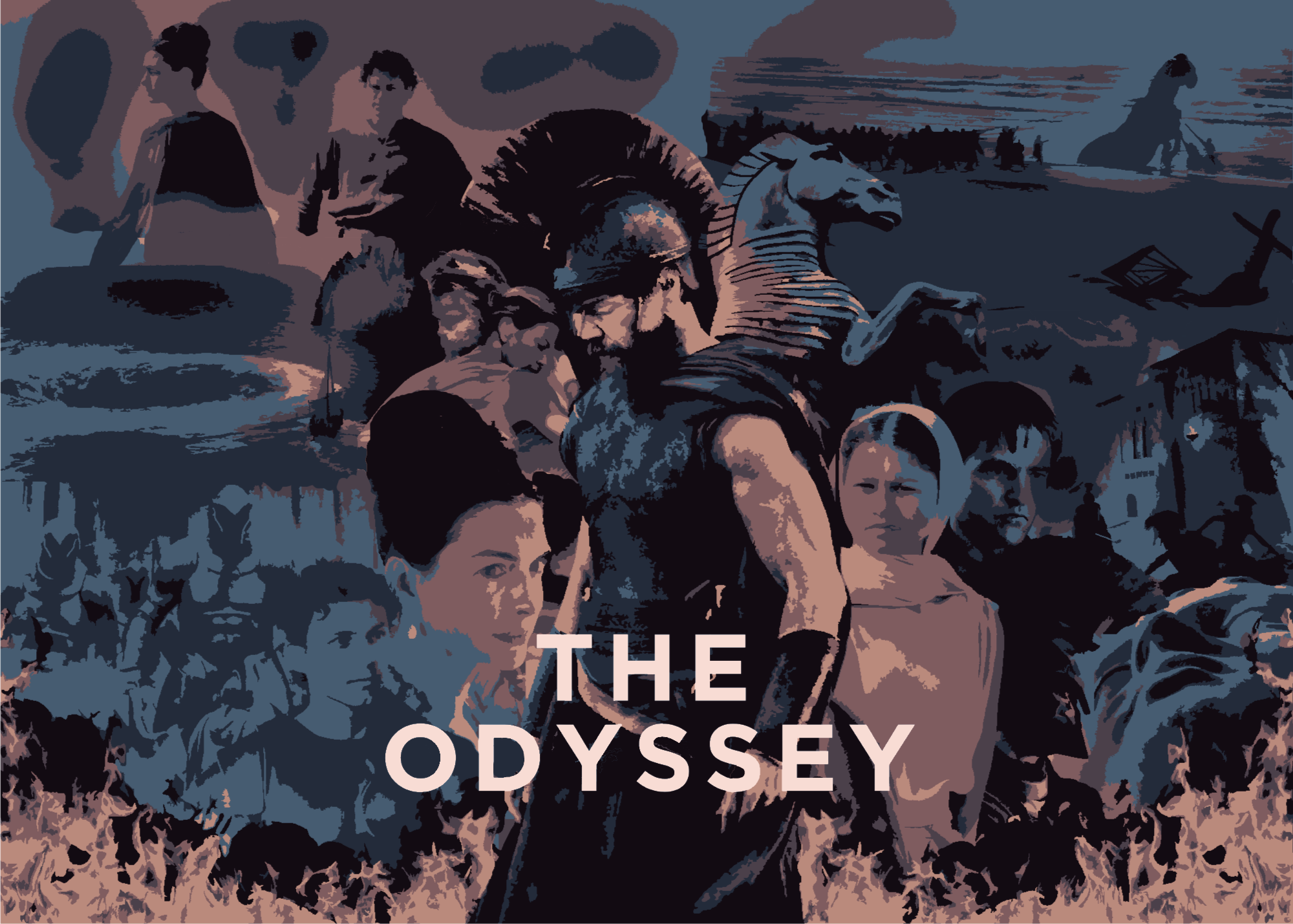
"The Odyssey" Review: Fantasically Crafted And Deeply Flawed
Nolan is up to his old tricks - both good and bad - in his sprawling adaptation of Homer's epic poem.
Recent ReleaseThroughout the millennia, humanity has recognized the need to find poetic language to explain complex concepts. Why? Frankly, we are dumb. You’re dumb. I’m dumb. We’re all dumb (but at least we’re dumb together). The simpler we can state the foundational truths of existence, the better. So, we developed proverbs to help.
For example, did you know that Rome wasn’t built in a day? In fact, it took nearly 32,000 days, and then earthquakes came and said, “lol.”
Did you know that you should never judge a book by its cover? You should judge it by the back cover.
Or did you know that beggars can’t be choosers, except for their choice to beg?
But the most hallowed of all proverbs, or at least the most difficult to accept, is the one that tells us that our missteps matter, and that we cannot wash our sins away through revisionism or desire: the road to hell is paved with good intentions.
Of course, no filmmaker will be sent to Hades for slipping up behind the lens, but the general idea that wanting to do something matters little in the face of whether or not you accomplished it holds firm. It forces people to weigh the general enjoyment and spectacle of a film against whether it met its lofty goals, and if a movie that gloriously executes the former can thus be forgiven for failing to achieve the latter.
In the case of The Odyssey, Christopher Nolan’s first outing since dominating the Oscars with Oppenheimer, we have an unfortunate revisit to some of his most troubling habits. Oh, how do I love thee, let me count the ways…
Upon the release of its trailer, The Odyssey attracted controversy for its casting, with many conservative outlets decrying the inclusion of transgender actor Elliot Page (assumed to have been cast as the great warrior, Achilles) and Lupita Nyong’o as Helen of Troy, since her being black contrasts the ethnic reality of Ancient Greece, despite the origin story being mythological in nature. Although there is a worthy discussion to be had regarding the acceptance of race-swapping an undeniably white character when this would be deemed unacceptable for any other race, the spirit of Nolan’s film is more of a Shakespearean tragedy, where it ultimately doesn’t matter who plays who, and race is therefore irrelevant.
The issue is that Nolan has overstuffed his movie with so many noteworthy faces that it is distracting, and the inclusion of so many in minor roles feels disingenuous. Nyong’o has so few scenes and so little dialogue that her presence is unnecessary. The same is true with Page, Jon Bernthal, Mia Goth, Logan Marshall-Green, and Corey Hawkins. It doesn’t help that everyone adopts an American accent, the modernity of which disrupts the immersion and exposes another foundational issue: the acting.
Matt Damon is a capable actor, but he’s not gifted, and certainly not versatile. The man is what he is, and so everyone had to follow suit. Unfortunately, a film marching to the beat of Damon’s drum will always struggle to stay in formation. Bernthal is atrocious, Page is strong in his monologue in the underworld, yet awkward otherwise. Meanwhile, Robert Pattinson and Anne Hathaway are brilliant as the sniveling Antinous and shrewdly loyal Penelope, respectively. Elsewhere, Himesh Patel flounders as Eurylochus, Odysseus’ faithless second-in-command, and Tom Holland is indecisive as the burgeoning Prince Telemachus. Yet, John Leguizamo shines as blind shepherd Eumaeus, Samantha Morton is eerie as the witch Circe, and Charlize Theron is quietly magnetic as the deceptive nymph Calypso. As for the man himself? Damon is brilliant as often as he’s middling.
We’ve seen Nolan’s actors struggle before, so perhaps The Odyssey has exposed that the strength of his players’ performances lies in the strength of the material they’re given: if it’s not a Nolan original, and he knows what to do with it, he’ll get gold, like in Oppenheimer. If he’s overreaching and making a pseudo-intellectual mess of a kernel of genius, the performances will show it, like Interstellar.
Of course, this is the signature of nearly all of Nolan’s work: strained, stilted dialogue and uneven thematic execution. The Odyssey measures up in this regard, often sounding like the creative writing project of an ambitious 14-year-old boy: simmering with potential, toying with possibility, but ultimately awkward and unrefined, thus incapable of reaching the height of its lofty ambitions. The excruciating longing stirred by the siren’s song is referred to as a “delicious itch,” and Odysseus is called a “lucky bastard” by his crewmate, and let’s not start on Odysseus’ monologue to Penelope about his reluctance to return to Ithaca after the Trojan War.
This signature amateurish writing exposes Nolan: beneath a crudely crafted facade is a superficiality that creates the impression of profundity where none exists. It’s aggravating. Nolan has an unearned reputation for nuanced thematics and expository commentary, but he’s the epitome of speaking much but having nothing to say. The ideas are there: somewhere along the way, humanity made a choice, one that shattered the core tenets of civilization, and we’ve proven unable to return.
Fair enough. If you think about it, money isn’t necessary. Theoretically, we could’ve always done things simply out of community and righteousness, but one day, eons ago, someone wanted something more for their trouble, and voila, exchange was born. But what of it? Anyone with a functioning brain cell could realize these things, so we don’t need to watch The Odyssey to conceive of them.
One could rake this fine-tooth comb over the whole film, but why? It all falters underneath even the slightest scrutiny. If Odysseus were tortured by the realizations he came to inside Troy, if it affected him so deeply he could not bring himself to want a homecoming, then why does he continue to make the same choices he had before? It begins properly, as he chooses a different path from Agammenon, whom he’s “followed long enough.” He shoots the Cyclops with the arrow. He has himself tied to the mast to hear the siren’s song. But then he is shades of the man from Homer’s poem, a tonal inconsistency severe enough to cripple the movie’s thematic ideals.
It doesn’t help that Nolan doesn’t truly understand this type of protagonist. From The Dark Knight to Oppenheimer, his “heroes” are, to whatever degree one imagines, complex, brooding, and intense. Odysseus is not such a man, so Nolan doesn’t know what to do with him. He tries to view him in a flawed, anti-heroic light, but there’s this underlying essence of classical heroism, so even though you can see the flaws, you never feel as though Nolan truly views him that way, and he doesn’t. His final scenes show this: he can be redeemed, given an opportunity to begin anew, so you know the shades of grey are a whisper in the wind. The songs will be sung, the mistakes forgotten in the light of a dark-breaking dawn. But if the context will ultimately be lost, then what is the movie actually about? Nothing.
So, if The Odyssey proves worthy of 1,000 words eviscerating its limp thematic execution, why is it still as good as a movie can be without being truly great? Because Nolan is a master technician, and so The Odyssey is one of the most gripping movies you’ll ever see in a theater, a technical masterclass so riveting it’ll easily cross $1 billion on well-earned repeat viewings.
No viewer will ever forget the horrific scream of the blinded Cyclops or the agonized pleas he sends to his father, Poseidon. No one will forget the sound of torrential rains beating down on the final ship in Odysseus’ fleet as the seas unleash vengeance for the men’s murder of Helios’ cattle. No one will forget the sounds of the Laestrygonians' massive blades ripping into the flesh of the fleeing men, the overwhelming fury of the Greek army running through Troy, releasing a decade of rage in a single night, or Agamemnon standing resolute as the Trojan gates open in the flame-lit night. The list of unforgettable moments and technical feats could not be written on the monstrous body of the Cyclops.
But even more than the technical ability is the creative choices that present a needed perspective that other films have not given. Wolfgang Petersen’s Troy glamorized the city, with sparkling armor and a feeling of elegance and regality in its customs and architecture. The horse is delivered upright, effortlessly pulled into a jubilant city. The men drop from the belly in the dead of night and open the gates without resistance, letting the Greeks flood the city.
Nolan takes a different approach. He shows us a previously unseen view of the men inside the horse, some of whom drown. Men urinate and defecate on one another; their muscles grow cold and stiff; they struggle to keep silent as hundreds of men slowly pull the horse from the beach into the city walls.
Inside the belly of the wooden beast, we glimpse the struggle these men have endured for a decade, and just why there’s so much wrath ready to eviscerate Troy, a city presented as austere. There’s something archaic and minimalist to its structure that makes it feel truly ancient, which hammers home a core idea. It’s not about who the Greeks did this to; the story doesn’t take sides like Troy, where the Greeks were villains and the Trojans noble. It only matters that what happened did, in fact, happen, and each cut to that happening, from the pulse-pounding opening of the gates to Odysseus’ final look to the burning horse, is majestic.
Even Nolan’s brief foray into body horror, when Circe transforms the men into swine, is brilliantly grotesque. As far as genre-blending and technical wizardry are concerned, there truly is nothing the man can’t do. Unfortunately, he fancies himself a thinker without the insight to think of something worthy to say. Nuance for the sake of nuance is a waste. The many shades of ethics, accountability, and leadership, etc., are not served by simply introducing concepts and leaving the threads dangling. You have to not only be intelligent but truly sharp, and while Nolan is an idea man, he is not sharp.
Ultimately, The Odyssey boils down to how you weigh entertainment vs. messaging. The Odyssey is not a well-executed commentary, and Nolan’s utter lack of growth in this respect is, at a diplomatic best, frustrating, as is his fans’ collective refusal to accept this and repeatedly fall into his “im14andthisisdeep” trappings. But there is no denying his knack for visual splendor and riveting spectacle, and The Odyssey, though not perfect in these ways, is as close to irreproachable as a movie can get. It’s awe-inspiring, chilling, intense, immersive, epic, horrifying, grand, formidable, and unforgettable. It’s alluring in every way you can quantify and in every way you can’t. As a technical achievement, it’s one of the best movies you’ll see, something perhaps only Nolan could ever have accomplished. It’s as fantastic in these respects as it is reductive in its ideological execution, yet splitting the difference still feels like a tall task.
In the end, it’s a gut thing and a matter of what is of greatest value, and sometimes movies can muddy those waters, which makes them as frustrating as fascinating. All in all, it will be said here as it was before: The Odyssey is as good as a movie can get without being truly great, so while Nolan’s song is not nearly as alluring as the sirens, we must commend him for his overall output. The road to hell is paved with good intentions, but Nolan’s skill as a technician saves him from Hades, and that’ll do.

83
Director: Christopher Nolan
Studio: Universal
Running Time: 173 minutes
Release Date: July 17, 2026
Cast:
Matt Damon - Odysseus
Anne Hathaway - Penelope
Tom Holland - Telemachus
John Leguizamo - Eumaeus
Robert Pattinson - Antinous
Himesh Patel - Eurylochus
Jon Bernthal - Menelaus
Lupita Nyong’o - Helen of Troy/Clytemnestra
Zendaya - Athena
Charlize Theron - Calypso
Samantha Morton - Circe
Benny Safdie - Agammenon
Corey Hawkins - Polybus
Elliot Page - Cinon
Ryan Hurst - Mentor
Screenplay: Christopher Nolan
Editor: Emma Thomas & Christopher Nolan
Cinematographer: Hoyte van Hoytema
Score: Ludwig Göransson
















.png)


.png)
Latest Entries
.jpeg)