
"Godzilla Minus Zero" Review: A Step-Up Sequel of Fantastically Monstrous Proportions
Takashi Yamazaki improves on his 2023 megahit with an exhilarating late-year blockbuster.
Recent ReleaseOn June 3, 1932, in the 9th inning of a game between the New York Yankees and Philadelphia Athletics at Shibe Park, Lou Gehrig hit a towering fly ball to center field. At 468 feet, it was one of the deepest caverns in the Majors. Athletics’ center fielder Al Simmons raced to the wall, leapt, and made an incredible catch. It didn’t affect the outcome; the Yankees won 23-13, but it robbed Gehrig of his fifth home run of the game.
Alas, four was plenty; Gehrig became the first player in the modern era to hit four home runs in a single game, a monumental, nearly unthinkable achievement. When Simmons reeled in Gehrig’s bid for number 5, the latter returned to the dugout, where Yankees’ manager Joe McCarthy assured him, “Well, Lou, no one can ever take today away from you.”
Except, someone did.
That same day, John McGraw, the long-time New York Giants manager whose career stretched back to the 19th century, retired. The announcement sent shockwaves throughout the game, and his decision dominated sports headlines across the country: Gehrig’s achievement became a footnote.
Ninety-four years later, the tide has turned: McGraw’s impact has been generally forgotten while the home run has become the sport’s calling card, and Gehrig’s legacy endures, both for his on-field accomplishments and tragic off-field fate.
Still, in that moment, it was McGraw who relegated Gehrig to the back burner, and in doing so, proved an undeniable, albeit unfortunate, truth about humanity:
If something monumental is happening, we really don’t give a shit about anything else.
In Godzilla Minus One, the 2023 hit kaiju film that stunned the box office and won an Academy Award, this was sadly forgotten. Amidst a triumphant cinematic return with incomparable effects and a distinct visual vision, director Takashi Yamazaki wasted our time trying to blend an epic monster movie with contemplative drama. The protagonist, Kōichi Shikishima, a WWII kamikaze pilot, struggles with survivor’s guilt and internalized cultural shame after faking technical difficulties with his plane to escape his duty, then failing to respond when Godzilla emerges to attack the small island he landed on. The film lets him absolve himself by standing up to the great monster, saving Japan.
Who cares?
Everything has its place, but not everything has its place within something else. Contrary to what the Jim Crow South would’ve had you believe, this does not apply to race. It can, however, apply to movies. Character exploration, thorough backstories, and redemption arcs (unfortunately, since they generally suck) have their place in movies. However, none of them have a place in a Godzilla movie, because Godzilla.
Occasionally, a big action movie can surprise us with a well-navigated foundational narrative, but it’s equivalent to a good side dish to a pricey main. If it’s stellar, it doesn’t hurt, but who cares about steamed broccoli when they have wagyu in front of them? Why put all the effort into the veg when the protein is the star?
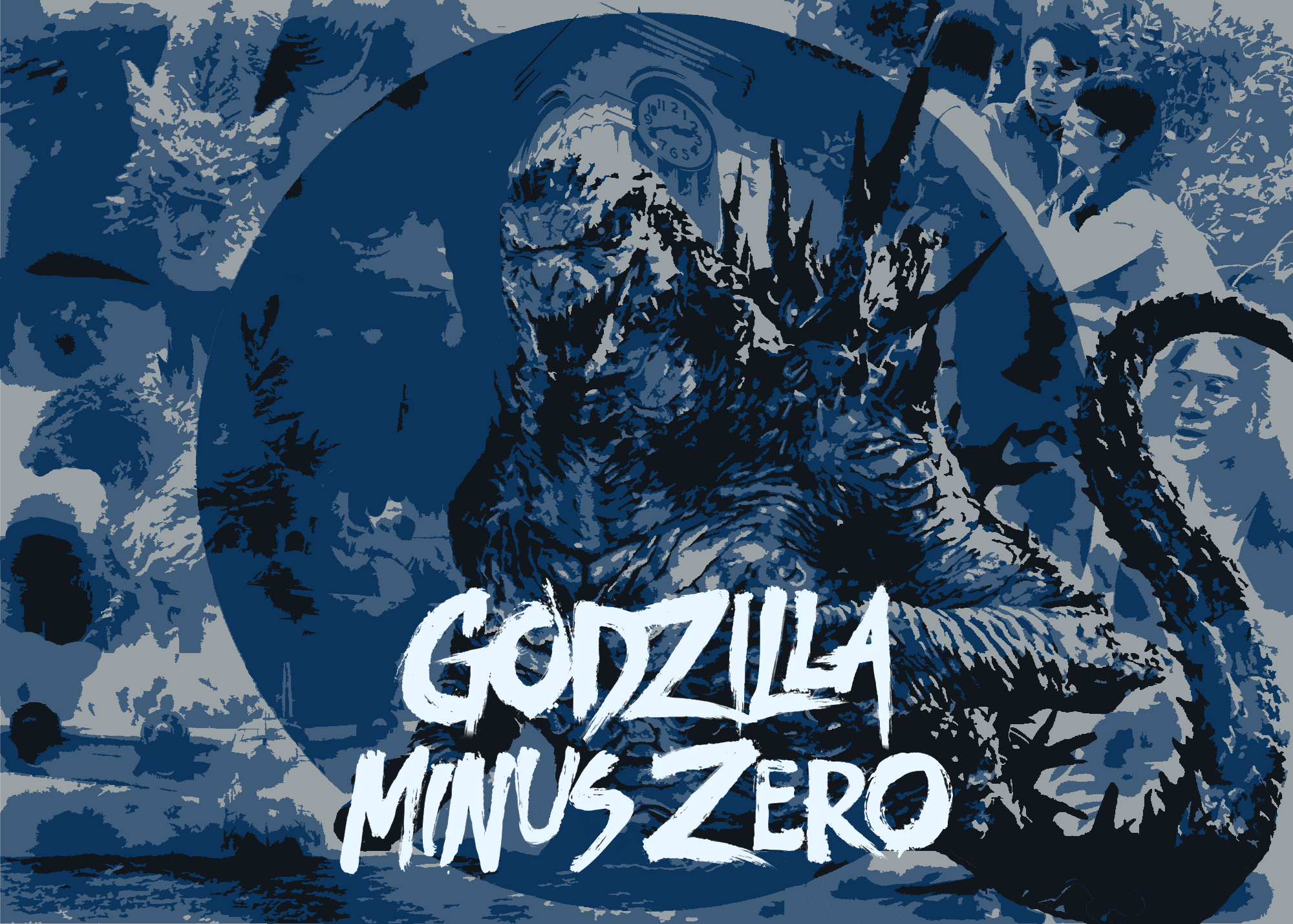
Thankfully, this problem was mostly solved in Godzilla Minus Zero (which, based on the logic for the initial title, shouldn’t it be Minus Two?). Although Shikishima returns with his wife Noriko and their adopted daughter, Akiko, he’s a vessel for a necessary overarching story, not a protagonist whose redemption arc we’re meant to care about while Godzilla unleashes his blinding blue heat ray and levels cities.
Minus Zero gives us the bare essentials: characters, a story, and dialogue. It makes general sense: Ghidorah, fallen from the skies, a strange creature from another world, has begun wreaking havoc on Japan. A draconic, regenerating beast, the humans' attempts to defeat it prove futile, only empowering the monster more. The only option becomes clear: pit the regenerated Godzilla against the new, three-headed King Ghidorah.
How did we get here? Well, it’d be a lie to say it all added up. We get the lazy heel turn where the villain is absolved so it can be the game-saver. One could argue it examines how we perceive weapons of mass destruction based on their value to us in any given situation, but that’s a stretch since the movie’s few attempts at such exploration fall flat. We have a man suffering from PTSD, envisioning Godzilla-induced nuclear revenge, which affects the story about 2% and is thus wrapped up with a pep talk shown in a quick flashback. We have Shikishima and Noriko, who bellyache over their role in the coming battles to stretch the runtime, only to do what they were always going to do as quickly as they started fake agonizing.
So, is the human element still present in Minus Zero? Yes, but it’s thankfully muted, because these movies aren’t built for that brand of storytelling. Top Gun: Maverick, the best action movie of the century, gave a simple romance and basic backstory, and let the general narrative develop them as much as possible. Yamazaki’s Godzilla movies don’t have that ability, by design and perhaps the director’s limitations. Whatever the reasons and to what extent, it’s built to be a great monster movie, because it’s freaking Godzilla.
As that monster movie, it fares remarkably well. Ghidorah’s design is incredible, and its regenerative, power-building abilities are truly imposing, an effective sidestep away from Godzilla and a compelling way to deepen the lore (which already exists, but still). The humans' inability to counter its seeming invulnerability leads to thrilling sequences despite their technical minimalism. Many movies would’ve worked the angles to find more action where it wasn’t needed, but Minus Zero knows when to give and when to withhold. More tension exists in lining up a lightning rod than a dozen explosions if you understand timing and restraint. The time for the big blasts will come.
When they do come, it’s some of the most electrifying action cinema you’ll get in an era of cookie-cutter blockbusters, with invigorating sound work and top-rate scoring. Ghidorah’s theme, while initially perplexing, becomes a sharp, alarming leitmotif that sets a unique sense of dread and foreboding.
Sadly, it disappoints a bit when the big showdown arrives. Without a clear vision for the two titans to duke it out, Yamazaki opts for a typical smackdown: Ghidorah clobbers Godzilla, then gets soundly defeated when Godzilla rebounds. We’ve seen this exact construction before, where the “hero” is unexpectedly raked over the coals and then wins swiftly with no explanation for how it went from beatdown to sweeping victory.
Still, there’s an underlying sense of thrills and high stakes throughout Minus Zero, and the highest highs soar above Minus One and most films of its kind. Arguably, it succeeds even more in the build-up to its grand visual bursts as when the gloves come off. Tension is the key to a truly great monster movie, and Minus Zero oozes it and then some. The human drama isn’t terribly convincing, but it mercifully opts not to develop it to the point of distraction. It’s a necessary component but gets smartly relegated to a lesser role in favor of the technical ability of an irresistible monster mash.
That’s it. There isn’t much to say, and that’s the beauty of a movie like this, and what ultimately makes it a step-up from Minus One. We aren’t worried about the people, because Godzilla (and Ghidorah) are fucking shit up, and that’s what counts. Lou Gehrig hit 493 home runs in his career; if four of them got the shaft because something shinier passed by, that’s okay. Home runs happen every day, but perfect games? Those are one in a million, so we need to stop and appreciate the magic when they do.

84
Director: Takashi Yamazaki
Studio: Toho Co.
Running Time: 135 minutes
Release Date: November 3, 2026
Cast:
Ryunosuke Kamiki - Kōichi Shikishima
Minami Hamabe - Noriko Shikishima
Min Tanaka - Kanji Murakami
Hidetaka Yoshioka - Kenji Noda
Masami Nagasawa - Makoto Aoyama
Sakura Ondo - Sumiko Ōta
Screenplay: Takashi Yamazaki
Editor: Ryūji Miyajima
Score: Naoki Satō
































Latest Entries